
The Developer Behind the Product: Lessons From Building, Breaking, and Starting Again
What failed projects, broken builds, difficult decisions, and starting over taught me about becoming a better builder.

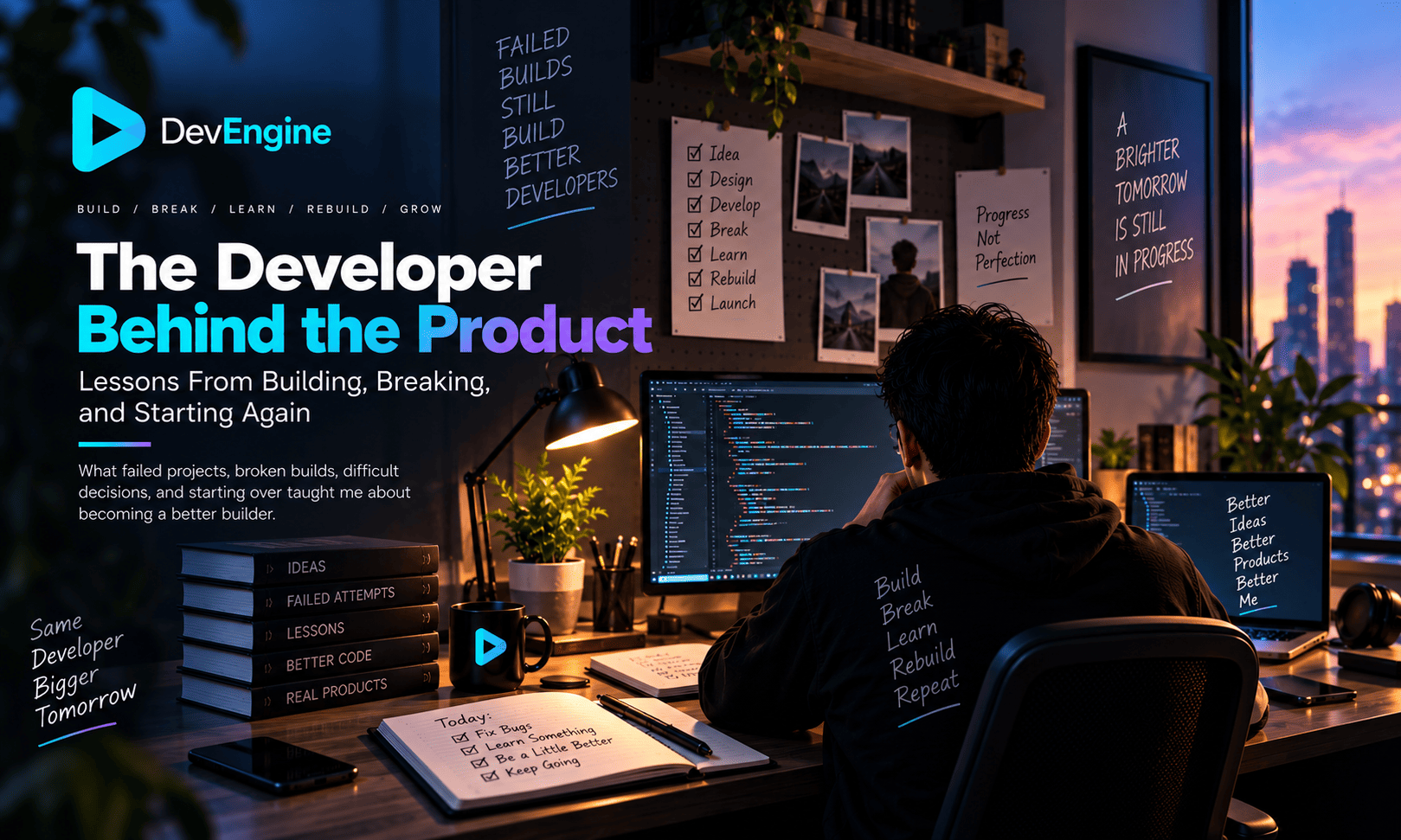
The Developer Behind the Product: Lessons From Building, Breaking, and Starting Again
People usually see the product.
They see the application.
They see the website.
They see the polished interface.
They see the announcement when something launches.
What they usually don't see is everything that happened before that moment.
The broken builds.
The confusing errors.
The architecture that had to be changed.
The feature that took much longer than expected.
The design that had to be rebuilt.
The deployment that didn't work.
The nights spent trying to understand a problem that seemed impossible.
And the moments when starting again felt easier than continuing.
That hidden part of development is where a lot of the real learning happens.
And much of what shaped DevEngine came from exactly that process.
The Developer Is Part of the Product
When you're building something yourself, it becomes difficult to separate the developer from the product.
Every technical decision reflects something you've learned.
Every architectural choice reflects experience.
Every shortcut reflects a decision about time and priorities.
Every mistake eventually becomes a lesson.
That's why building software isn't only about creating applications.
It also changes the person creating them.
Every project leaves something behind.
Sometimes it's code.
Sometimes it's documentation.
Sometimes it's a reusable component.
And sometimes it's simply better judgment.
The First Lesson: Things Rarely Go Exactly as Planned
A project plan can look perfectly reasonable.
The features are listed.
The timeline seems manageable.
The architecture makes sense.
The design is ready.
Then development begins.
And reality starts changing the plan.
A dependency behaves differently than expected.
A feature turns out to be more complicated.
The database needs a different structure.
A requirement changes.
A new edge case appears.
A deployment introduces a problem nobody saw during development.
Suddenly, the original timeline doesn't make sense anymore.
This taught me something important:
A plan is a direction.
It isn't a prediction of the future.
Good development requires enough structure to stay organized and enough flexibility to adapt.
The Second Lesson: Debugging Is Part of Engineering
There is a romantic version of programming where developers write code and applications simply work.
Real development isn't like that.
Sometimes the screen is blank.
Sometimes the API returns something unexpected.
Sometimes authentication works on one device and fails on another.
Sometimes a database rule blocks a query.
Sometimes the error message doesn't immediately tell you what actually went wrong.
And sometimes the bug disappears the moment you try to reproduce it.
Debugging can be frustrating.
But it is also one of the most valuable engineering skills.
The important question isn't:
"How quickly can I fix this?"
It is:
"How can I understand why this happened?"
A quick patch can remove an error.
Understanding the root cause can prevent the same class of problem from appearing again.
The Third Lesson: Not Every Solution Should Be Saved
One of the hardest lessons for a developer is accepting that some code should be deleted.
You can spend hours building something.
You can become emotionally attached to the solution.
You can think:
"I've already invested so much time into this."
But time already spent shouldn't determine whether something deserves to remain.
Sometimes the cleanest solution is to remove the old implementation and build it again.
Not because the previous work was worthless.
Because the previous work taught you what the next version needs.
That is not wasted effort.
That is learning.
Starting Over Doesn't Mean Starting From Nothing
This distinction changed how I think about rebuilding.
When you start a project again, you don't actually return to zero.
You carry experience with you.
You know what caused problems.
You know which assumptions were wrong.
You know which architecture became difficult to maintain.
You know which feature wasn't worth the complexity.
You know which workflow confused users.
You know what you would do differently.
The code may be gone.
The experience isn't.
The Fourth Lesson: Complexity Grows Quietly
Complexity rarely arrives all at once.
It usually starts with something small.
"Let's just add this one condition."
Then another.
Then a special case.
Then another exception.
Then another dependency.
Then another workaround.
Eventually, something that looked simple becomes difficult to understand.
This is one of the reasons I became more careful about abstraction.
Abstraction can be powerful.
But unnecessary abstraction can hide complexity rather than remove it.
A good system isn't the one with the most layers.
It is the one where each layer has a clear reason to exist.
The Fifth Lesson: Copying Patterns Isn't the Same as Understanding Them
The software world moves quickly.
There is always a new architecture.
A new framework.
A new library.
A new design trend.
A new "best practice."
It is tempting to copy whatever successful teams are doing.
But a pattern only makes sense when you understand the problem it was created to solve.
A sophisticated architecture designed for a massive platform may be completely unnecessary for a small application.
A library designed for one use case may create unnecessary complexity in another.
Technology should be understood before it is adopted.
That's something I try to remember every time I make a technical decision.
The Sixth Lesson: The User Doesn't Care How Clever the Code Is
Developers naturally care about the engineering underneath.
We notice architecture.
We notice performance.
We notice elegant abstractions.
We notice clean code.
Users usually don't.
And that's okay.
The user wants the application to be understandable.
Fast enough.
Reliable.
Useful.
Predictable.
They don't need to know how beautiful the repository looks.
This is an important reminder.
Engineering quality matters.
But engineering quality exists to support the product and the people using it.
The Seventh Lesson: Beautiful Software Can Still Be Difficult
A beautiful interface doesn't automatically mean a good experience.
A screen can look incredible while hiding the action the user actually needs.
A dashboard can contain beautiful charts but provide no useful information.
An animation can look impressive while making the application feel slower.
A complicated navigation system can look sophisticated while confusing users.
Design needs purpose.
The goal isn't to make every screen impressive.
The goal is to make the product understandable.
The Eighth Lesson: Shipping Changes Everything
Before software reaches users, many decisions are based on assumptions.
We assume the workflow makes sense.
We assume the performance is acceptable.
We assume users will understand the interface.
We assume the system will behave correctly under real conditions.
Then we ship.
Reality answers those assumptions.
Sometimes the answer is exactly what we expected.
Sometimes it isn't.
That's why shipping is so valuable.
A product in production teaches you things that development alone cannot.
The Ninth Lesson: Feedback Can Hurt and Help
Not every piece of feedback feels good.
Sometimes someone points out a problem you spent days working on.
Sometimes a user doesn't understand something you thought was obvious.
Sometimes a feature you were proud of barely gets used.
That can be difficult.
But feedback isn't necessarily criticism of the developer.
It is information about the product.
And information is useful.
The question becomes:
"What can this teach us?"
That mindset makes it easier to improve without becoming defensive.
The Tenth Lesson: You Don't Need to Know Everything
One of the biggest traps in software development is feeling like you should already know the answer.
You don't.
No developer knows everything.
There will always be technologies you haven't used.
Architectures you haven't implemented.
Problems you've never encountered.
Systems you don't understand yet.
The ability to say:
"I don't know."
is not weakness.
The important part is what comes next:
"Let me learn."
Learning Became Part of the Work
At some point, I stopped thinking of learning as something that happens before development.
Learning is development.
When a project requires something unfamiliar, learning becomes part of the project.
Read the documentation.
Build a small experiment.
Test the behavior.
Break it.
Understand it.
Then implement it.
This approach makes unfamiliar technologies much less intimidating.
You don't need to understand everything before beginning.
You need to be willing to understand what the problem requires.
The Hardest Part Is Sometimes Continuing
There are moments in development when progress feels invisible.
You've been working for hours.
The application still doesn't work.
The bug is still there.
The feature is still unfinished.
The deadline is getting closer.
It can feel like nothing is moving.
Those moments are difficult because software development often produces delayed rewards.
You can spend an entire day solving a problem that users will never know existed.
But that invisible work still matters.
Sometimes progress is simply removing one obstacle.
Then another.
Then another.
Eventually, the system moves again.
Failure Changed How I Define Progress
Earlier in the journey, progress meant adding things.
More screens.
More features.
More code.
More functionality.
Over time, that definition changed.
Progress can also mean removing something.
Removing unnecessary complexity.
Removing a fragile dependency.
Removing a confusing workflow.
Removing a feature that doesn't belong.
Reducing a slow operation.
Reducing the number of steps a user needs.
Sometimes the best progress makes the product smaller.
The Developer Has to Grow Too
A company can improve its tools.
A project can improve its architecture.
A product can improve its interface.
But none of that happens consistently unless the people building it improve too.
That means becoming better at:
- Communication
- Planning
- Debugging
- Architecture
- Design thinking
- Documentation
- Testing
- Decision-making
- Time management
- Learning
Technical ability is only one part of becoming a better developer.
Judgment becomes increasingly important.
What Failure Actually Gave Me
Failure gave me something success couldn't.
Perspective.
A successful implementation can show you that something worked.
A failed implementation can force you to understand why.
Why was the assumption wrong?
Why did the architecture become difficult?
Why did the feature take so long?
Why did the user struggle?
Why did the deployment fail?
Why did the original plan stop making sense?
Those questions are valuable.
They make future decisions better.
Building DevEngine With Those Lessons
All of these experiences influence how I think about DevEngine.
I don't want the company to be built around the idea that every project will be perfect.
I want it to be built around continuous improvement.
Understand before building.
Keep complexity intentional.
Test against reality.
Ship.
Listen.
Learn.
Rebuild when necessary.
Improve.
The process matters as much as the final product.
There Will Always Be Another Failure
Building software means encountering problems.
Even with experience.
Even with planning.
Even with good architecture.
Something will eventually go wrong.
A dependency will change.
A requirement will move.
A deployment will fail.
A user will discover an unexpected edge case.
A decision will turn out to be wrong.
The goal isn't to create a world without failure.
That isn't realistic.
The goal is to build the ability to respond.
Build, Break, Learn, Rebuild
If I had to describe the journey in four words, they would be:
Build. Break. Learn. Rebuild.
Build something.
Discover its weaknesses.
Understand what went wrong.
Then make the next version better.
That cycle has shaped more of my development journey than any single programming language or framework.
And it continues to shape DevEngine.
The Person Behind the Product
Every product has a story behind it.
And behind that story are people.
Developers learning.
Designers refining.
Founders changing direction.
Teams solving problems.
Users providing feedback.
The polished product is only the visible layer.
The real work happens underneath.
That's where the lessons are.
That's where the growth happens.
That's where the next version begins.
Starting Again Is Still Moving Forward
There will always be projects that need rebuilding.
There will always be decisions that need revisiting.
There will always be things we could have done better.
That's not evidence that the journey isn't working.
It's part of the journey.
The important thing is not whether we had to start again.
The important thing is what we learned before starting again.
Because when you rebuild with better understanding, you're not going backward.
You're building from experience.
Still Learning
DevEngine is still growing.
I'm still learning.
There are still technologies I haven't explored.
There are still mistakes I haven't made yet.
There are still problems I don't know how to solve.
And that's okay.
The goal isn't to reach a point where there is nothing left to learn.
The goal is to keep becoming better at learning, building, and adapting.
The Next Version Is Always Possible
A broken project can be rebuilt.
A bad decision can be corrected.
A confusing feature can be redesigned.
A difficult architecture can be simplified.
A failed idea can teach the next one.
That is one of the most useful things I've learned from software development.
Nothing has to be the final version.
There is always an opportunity to improve.
Keep Building
The developer behind a product is constantly changing.
Every project leaves something behind.
Every failure adds context.
Every successful release adds confidence.
Every difficult problem adds experience.
Eventually, those experiences become judgment.
And judgment becomes part of how you build.
That's the journey I'm still on.
That's part of the journey behind DevEngine.
Not a story about getting everything right.
A story about continuing to build.
Continuing to learn.
Continuing to improve.
And when necessary—
starting again.
We explored similar production pitfalls in our article on why software projects fail before code is finished.