
Why Most Software Projects Fail Before the Code Is Finished
The biggest problems in software rarely begin with bad code. They begin with unclear problems, weak planning, and decisions made too early.

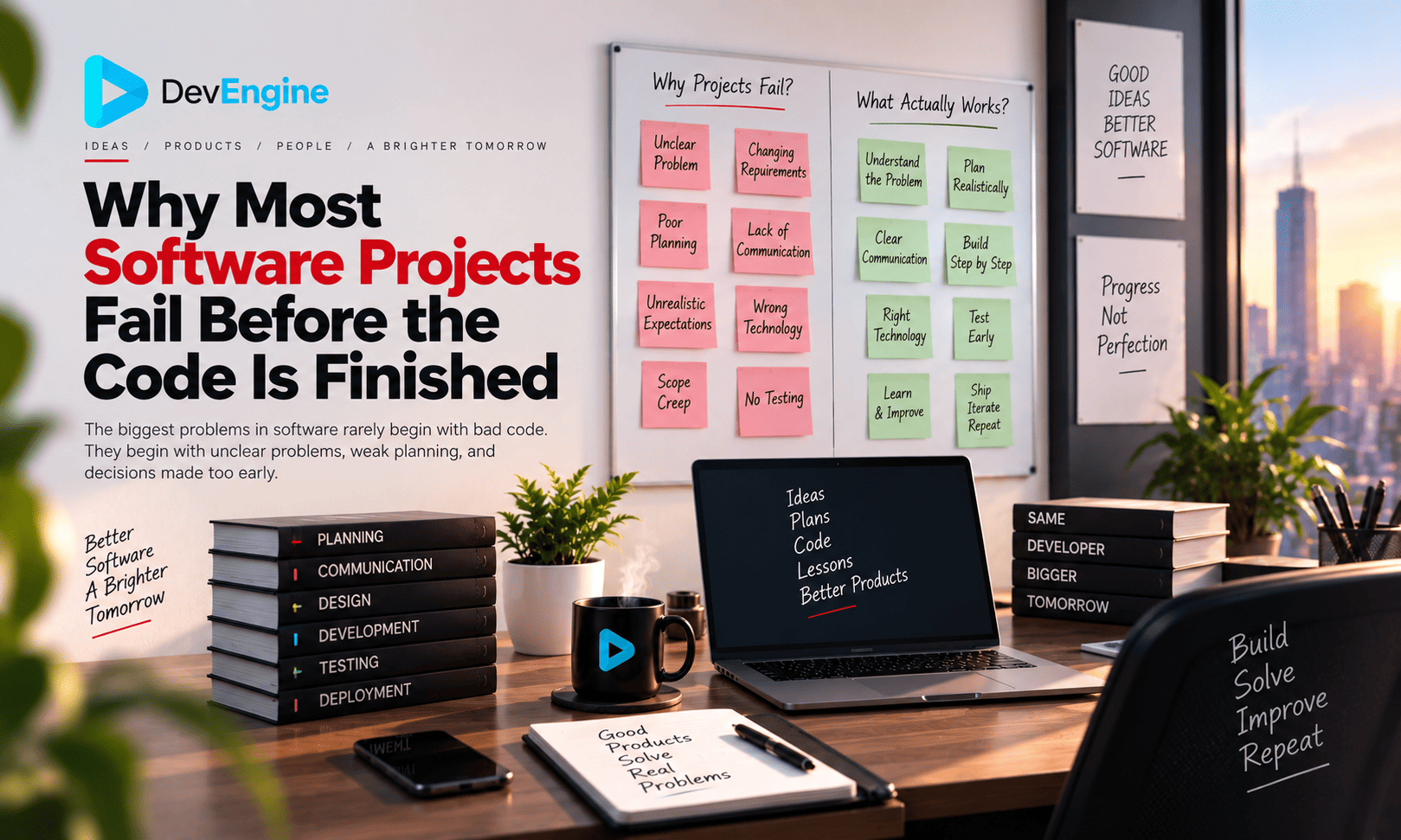
Why Most Software Projects Fail Before the Code Is Finished
A software project can have talented developers.
It can use modern technology.
It can have a beautiful design.
It can have a detailed development plan.
And it can still fail.
Sometimes the reason isn't a bug.
Sometimes it isn't performance.
Sometimes it isn't even the technology.
The problem started much earlier.
It started when the project was still an idea.
The Code Usually Isn't the First Problem
When a software project goes wrong, the easiest thing to blame is the code.
The developer wrote something incorrectly.
The application is slow.
The architecture became complicated.
The database wasn't designed properly.
The deployment failed.
Those things can certainly cause problems.
But many of the biggest problems existed before the first line of code was written.
A team can write excellent code for the wrong product.
A team can build a technically impressive feature that users don't need.
A team can spend months developing something that was based on an incorrect assumption.
That's why good software engineering begins before development.
Problem One: Building Before Understanding
One of the most common mistakes is starting development too early.
Someone has an idea.
The idea sounds useful.
Everyone gets excited.
A designer starts creating screens.
Developers start building.
Features begin appearing.
And suddenly the project has momentum.
But nobody has stopped to properly define the problem.
Who is the user?
What problem are they experiencing?
How frequently does it happen?
What are they doing today instead?
Why would they change their current behavior?
What does success actually look like?
Without those answers, development becomes a guessing game.
And guessing gets expensive as the project grows.
A Feature Is Not a Problem
This distinction is incredibly important.
"Users need a notification system."
That's a feature.
"Users don't know when something important has changed."
That's a problem.
Those two statements lead to very different solutions.
Maybe the answer is a notification.
Maybe it's an email.
Maybe it's an in-app status indicator.
Maybe the workflow itself needs to change.
If we start with the feature, we've already decided on the solution.
If we start with the problem, we still have room to find the right solution.
That's why we believe the problem should come before the feature.
Problem Two: Trying to Build Everything
Another common problem is scope.
A project starts with five features.
Then someone adds another.
Then another.
Then someone says:
"Since we're already building this, can we also add..."
Eventually, the original product becomes a collection of everything anyone has ever wanted.
More screens.
More workflows.
More database collections.
More APIs.
More permissions.
More edge cases.
More testing.
More maintenance.
More things that can break.
Complexity grows faster than most teams expect.
That's why a good first version isn't necessarily the version with the most features.
It is often the version that proves the most important assumption with the least unnecessary complexity.
The Power of Saying "Not Yet"
One of the hardest decisions in product development is saying:
Not yet.
Not:
"No forever."
Just:
"Not in this version."
That distinction matters.
A feature can be useful and still not belong in version one.
A feature can be technically impressive and still not solve the most important problem.
A feature can even be requested by users and still require more research before implementation.
Good product development is partly about deciding what to build.
But it is also about deciding what not to build yet.
Problem Three: Designing for the Perfect User
There is no perfect user.
Real users have slow internet.
They use different devices.
They misunderstand instructions.
They make mistakes.
They enter unexpected data.
They close the application halfway through an operation.
They forget passwords.
They tap buttons multiple times.
They use features in ways nobody expected.
A system that only works when everything goes perfectly isn't finished.
It is only working under ideal conditions.
Good software has to account for reality.
Error States Are Part of the Product
Consider a simple login screen.
The successful flow is easy:
Enter email.
Enter password.
Tap login.
Open dashboard.
But what happens when:
- The password is incorrect?
- The internet disappears?
- The server is unavailable?
- The account doesn't exist?
- The request takes too long?
- The user taps the button five times?
- Authentication succeeds but the profile fails to load?
These aren't unusual situations.
They are part of the product.
The difference between a prototype and production software is often how well the system handles everything that happens outside the happy path.
Problem Four: Choosing Technology Too Early
Technology is exciting.
A new framework appears.
A new database becomes popular.
A new architecture promises scalability.
A new library makes development faster.
It is tempting to choose the technology first and then shape the project around it.
That can be backwards.
The technology should serve the product.
Not the other way around.
The right question isn't:
"What is the most modern technology we can use?"
A better question is:
"What technology makes sense for this product, this team, this timeline, and this expected scale?"
Sometimes the answer is something new.
Sometimes it is something boring.
Boring can be good.
Problem Five: Architecture Designed for a Future That May Never Arrive
Developers naturally think about the future.
That's part of our job.
But there is a difference between preparing for growth and building for imaginary growth.
A small product doesn't necessarily need an enormous distributed architecture.
A simple workflow doesn't necessarily need ten services.
A startup doesn't necessarily need infrastructure designed for millions of users before it has its first hundred.
Overengineering has a cost.
Every additional layer introduces more:
- Configuration
- Maintenance
- Monitoring
- Debugging
- Deployment complexity
- Failure points
Architecture should be appropriate for the actual problem.
And it should leave enough room to evolve.
Problem Six: Treating Design and Development as Separate Worlds
A design can look perfect in Figma.
Then the developer implements it.
And reality appears.
Text wraps differently.
Content is longer than the designer expected.
A button doesn't fit on a smaller screen.
A loading state wasn't designed.
An error message breaks the layout.
The database returns an empty list.
A user doesn't have permission to see something.
This is why design and engineering need to communicate continuously.
A product isn't designed first and engineered afterward.
The two disciplines should influence each other throughout the process.
Problem Seven: Ignoring the Data
The interface is what users see.
The data is what keeps the system alive.
Poor data modeling can create problems everywhere.
Queries become complicated.
Relationships become difficult to maintain.
Permissions become harder to enforce.
Reports become unreliable.
Features require increasingly complex workarounds.
The application may look simple while the underlying system becomes increasingly fragile.
Good architecture considers the data model early.
Not because database diagrams are exciting.
Because changing fundamental data structures after a product is already in production can be expensive.
Problem Eight: Security as an Afterthought
Security shouldn't be a final checklist.
It should be part of the architecture.
Who can access this data?
Who can modify it?
What happens if someone manipulates the client application?
Can a user access another user's information?
What happens when authentication expires?
Can an administrator perform an operation that shouldn't be available to normal users?
These questions should be considered during development.
A polished interface doesn't make an insecure system secure.
Problem Nine: Testing Only What Works
Another common mistake is testing the happy path.
The developer creates an account.
It works.
The developer submits a form.
It works.
The developer opens the dashboard.
It works.
Then the product reaches real users.
And everything changes.
Real testing should also ask:
What if the input is empty?
What if it is extremely long?
What if the network disappears?
What if the request returns an error?
What if the user repeats the action?
What if the database returns nothing?
What if the user has an unexpected role?
What if the application is reopened halfway through a process?
Testing isn't about proving that the product works once.
It is about discovering how it behaves when reality disagrees with our assumptions.
Problem Ten: Thinking That Launch Is the Finish Line
A launch is not the end of development.
It is the beginning of the next stage.
Before launch, we work with assumptions.
After launch, we get evidence.
Users reveal things we couldn't predict.
They find confusing workflows.
They discover edge cases.
They request new capabilities.
They use existing features differently than expected.
That information is incredibly valuable.
A product should evolve based on what we learn.
What We Try to Do Differently
At DevEngine, we're still learning this process ourselves.
We don't pretend that every project has been perfect.
It hasn't.
But experience has taught us to pay attention to the parts that happen before and around the code.
We try to begin with the problem.
Then define the user.
Then establish the essential workflow.
Then decide what the first version actually needs.
Then choose technology based on the problem.
Then design and engineer together.
Then test beyond the happy path.
Then ship.
Then learn.
Then improve.
It sounds simple.
The difficult part is doing it consistently.
A Better Software Process Is Usually Less Complicated
Good engineering doesn't necessarily mean adding more.
Sometimes it means removing.
Remove unnecessary features.
Remove unnecessary dependencies.
Remove unnecessary abstraction.
Remove unnecessary steps.
Remove assumptions that aren't supported by evidence.
The result isn't always more sophisticated.
Sometimes it is simply clearer.
And clarity is incredibly valuable in software.
The Real Cost of Building the Wrong Thing
The most expensive software mistake isn't always writing bad code.
Sometimes it is writing thousands of lines of perfectly functioning code for a problem that didn't need to be solved that way.
The earlier we discover that we're heading in the wrong direction, the cheaper it is to change direction.
That's why planning matters.
That's why prototypes matter.
That's why feedback matters.
That's why small releases matter.
They allow us to learn before the cost of being wrong becomes enormous.
Software Engineering Is Decision Engineering
At the end of the day, software development isn't only about syntax.
It's about decisions.
What should we build?
What shouldn't we build?
How should the system behave?
Where should the complexity live?
What should happen when something fails?
Which technology makes sense?
What should we optimize?
What can wait?
What needs to be secure?
What does the user actually need?
Every line of code is the result of a decision.
The quality of the product depends heavily on the quality of those decisions.
The Goal Isn't Perfect Software
Perfect software doesn't exist.
There will always be another edge case.
Another optimization.
Another feature.
Another improvement.
Another bug.
The goal is something more practical.
Build software that solves the intended problem.
Build it responsibly.
Build it in a way that can evolve.
Listen to reality.
Then make the next version better.
Before We Write the Next Line
Before opening the editor, there are a few questions worth asking:
What problem are we solving?
Who are we solving it for?
What is the smallest useful version?
What assumptions are we making?
What could go wrong?
What will success look like?
What can we learn before building everything?
Those questions don't eliminate failure.
Nothing can.
But they can make failure cheaper, learning faster, and the path forward clearer.
That's the kind of engineering process we're trying to build at DevEngine.
Not a promise that everything will go perfectly.
A commitment to understand the problem, make thoughtful decisions, learn from reality, and keep improving.
Because sometimes the most important part of software development isn't writing the code.
It's knowing what code should be written in the first place.
If you are preparing a new project and want to review our approach to architecture and delivery, explore our software engineering services.