
Why We Build From the Ground Up Instead of Following Every Trend
why-we-build-from-the-ground-up-instead-of-following-every-trend

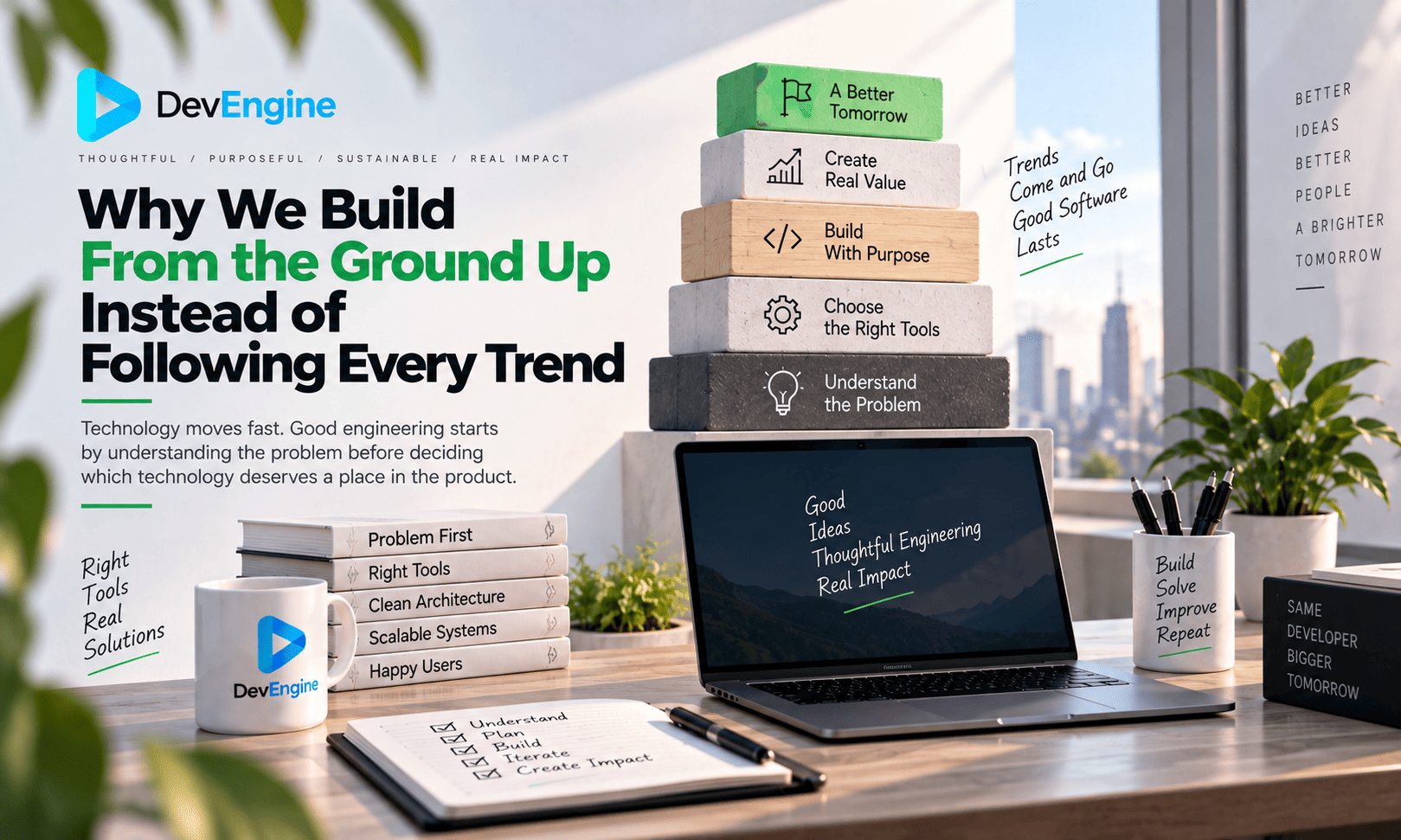
Why We Build From the Ground Up Instead of Following Every Trend
Software moves incredibly fast.
A new framework appears.
A new library becomes popular.
A new architecture starts trending.
A new AI tool promises to change development.
A new technology becomes the thing everyone is talking about.
Then another one arrives.
And another.
For developers, keeping up can feel like a full-time job.
But there is an important question behind all of this:
Do we actually need to use everything that is new?
At DevEngine, the answer is no.
We'd rather understand the problem first and choose technology second.
Technology Is a Tool, Not the Product
It is easy to become excited about technology.
A new framework can make development feel faster.
A new library can solve a difficult problem.
A new architecture can look incredibly sophisticated.
But the technology itself isn't the goal.
The product is.
If a simple solution solves the problem reliably, there may be no reason to replace it with a complicated one just because something newer exists.
Good engineering isn't about using the most technologies.
It's about making the right decisions.
The Problem Comes First
Before deciding how to build something, we try to understand what we're building.
Who will use it?
What are they trying to accomplish?
What information does the system need?
What needs to happen in real time?
What can happen asynchronously?
What needs to be secure?
What needs to scale?
What needs to be simple?
Only after understanding those questions does technology become part of the conversation.
The stack should follow the requirements.
Not the other way around.
Why "Modern" Doesn't Always Mean "Better"
A technology can be modern and still be the wrong choice.
It may introduce unnecessary complexity.
The ecosystem may be immature.
The team may not have enough experience with it.
Documentation may be limited.
Deployment may become more difficult.
Or perhaps the existing solution already works perfectly well.
Using something newer doesn't automatically make the product better.
Sometimes the most responsible engineering decision is choosing the technology that is proven, understandable, and appropriate.
Build From What We Understand
There is another reason we care about understanding the foundation.
When developers rely too heavily on abstractions, it becomes easy to forget what is actually happening underneath.
A framework can hide the networking.
A library can hide the state management.
A service can hide the infrastructure.
An abstraction can hide the complexity.
Abstractions are useful.
But we should still understand what they are doing for us.
Because when something breaks, the abstraction may not be able to explain the problem.
The developer has to.
Simple Doesn't Mean Basic
There is a misconception that simple systems are somehow less sophisticated.
That's not necessarily true.
A simple architecture can require significant engineering judgment.
The difficult part isn't adding another layer.
Sometimes the difficult part is deciding that another layer isn't necessary.
Simple systems can be easier to:
- Understand
- Test
- Deploy
- Debug
- Maintain
- Explain
- Change
Simplicity is not the absence of engineering.
Often, it is the result of good engineering.
We Still Experiment
Building from the ground up doesn't mean avoiding new technology.
Quite the opposite.
We experiment constantly.
We try new frameworks.
We explore new tools.
We test new approaches.
We learn new APIs.
We experiment with AI.
But experimentation and production are different things.
A tool can be interesting without being ready for every project.
A technology can be promising without being appropriate for a particular product.
The goal is to explore without blindly depending on everything we discover.
The Difference Between a Trend and a Useful Tool
A trend asks:
"Is everyone using this?"
Engineering asks:
"Does this solve our problem?"
Those questions lead to very different decisions.
Popularity can be useful information.
It can tell us that a technology has community support.
But popularity isn't enough.
We still need to understand:
Does it fit the product?
Does it fit the team?
Does it fit the timeline?
Does it fit the expected scale?
Does it make the system better?
If the answer is no, there may be no reason to use it.
Build for Today, Leave Room for Tomorrow
There is another balance we try to maintain.
We don't want to overengineer for a future that may never arrive.
But we also don't want to create a system that makes every future change painful.
The goal is somewhere in between.
Build what the product actually needs today.
Structure it clearly enough that tomorrow's changes are possible.
That means avoiding unnecessary complexity while keeping the architecture understandable and adaptable.
Technology Will Keep Changing
The tools we use today won't necessarily be the tools we use five years from now.
That's normal.
Frameworks change.
Platforms change.
Programming languages evolve.
Development workflows change.
AI will continue changing how software is built.
Trying to build a company around one specific technology forever would be shortsighted.
The technology can change.
The engineering principles shouldn't have to.
What We Want DevEngine to Stand For
We want DevEngine to be technology-aware without becoming technology-obsessed.
We want to experiment without chasing every trend.
We want to use modern tools without assuming modern always means better.
We want to understand the fundamentals beneath the abstractions.
And most importantly, we want the technology to serve the product.
That's the philosophy.
Understand the problem.
Choose intentionally.
Build clearly.
Keep complexity under control.
Experiment constantly.
Replace things when there is a good reason.
And never confuse a popular tool with a good solution.
Build the Right Thing With the Right Tools
There will always be another framework.
Another library.
Another architecture.
Another trend.
Another tool promising to make everything faster.
That's okay.
We don't need to chase all of them.
Because building software isn't a race to use the newest technology.
It's a process of solving problems.
Sometimes the best technology is the newest thing you've discovered.
Sometimes it's something you've been using for years.
The important part is knowing why you chose it.
That's what building from the ground up means to us.
Not ignoring the future.
Not rejecting innovation.
But making technology earn its place in the product.
To understand how we structure source code ownership and licensing for long-term independence, review our software licensing models.