
Why Software Security Must Begin Before Development
How secure architecture, thoughtful engineering, and proactive risk management help businesses build trustworthy digital products.

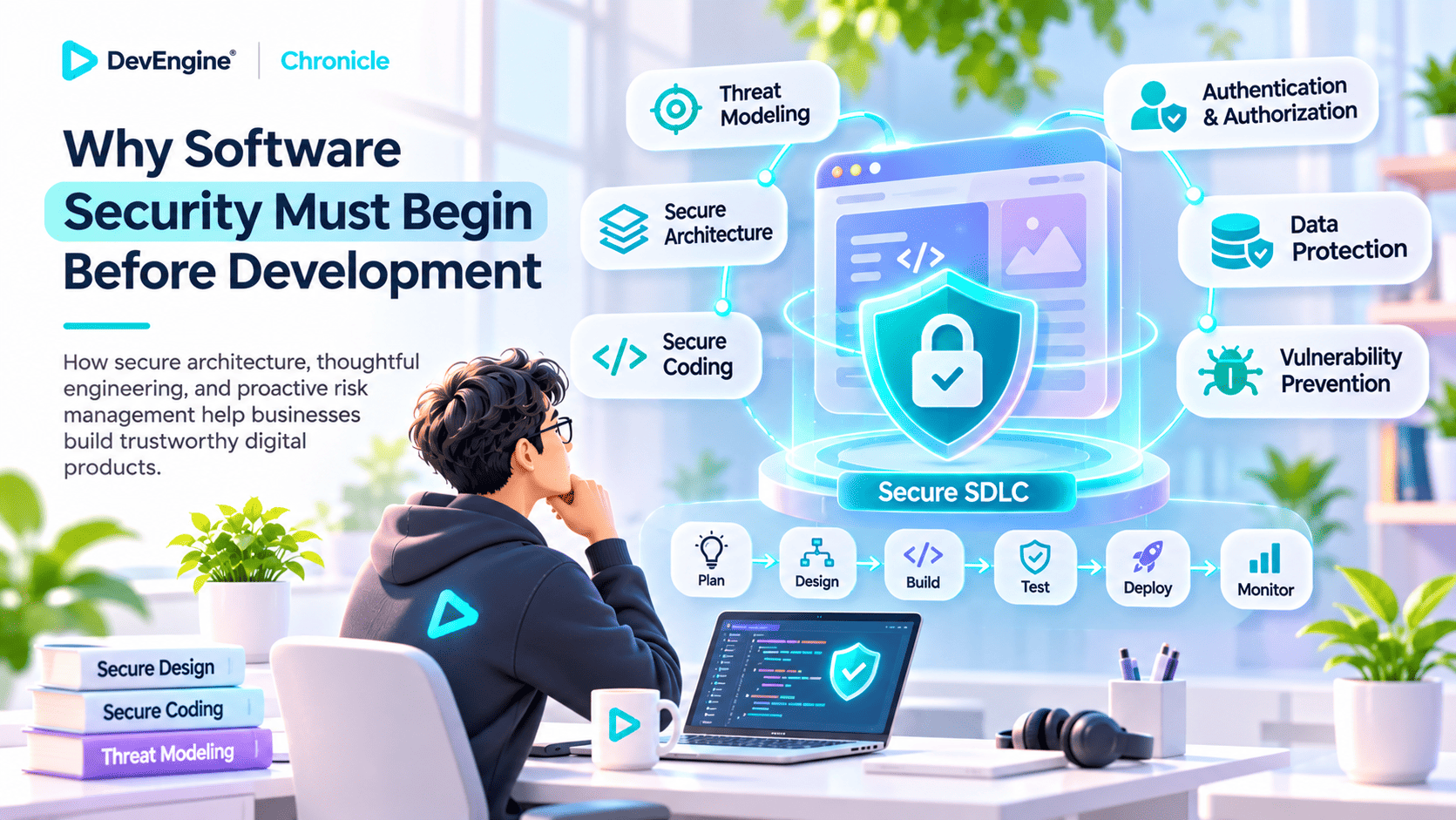
Why Software Security Must Begin Before Development
Building software is not simply about creating features, designing interfaces, or making applications work as expected. Every digital product also carries a responsibility to protect the information, systems, and people who depend on it.
A beautifully designed application can still become a serious business risk if its authentication is weak, sensitive information is exposed, or its backend accepts unauthorized operations.
Unfortunately, security is sometimes treated as something that developers should address near the end of a project. Teams focus on functionality first and plan to review vulnerabilities before launch.
That approach can create expensive problems.
Security decisions made during architecture and development can influence how easily a product can be protected, maintained, and improved over time.
As digital products become more connected, software security must become part of the engineering process from the very beginning.
1. Security Is an Architectural Decision, Not Just a Final Check
One of the most common misconceptions about software security is that it can be added after development is complete.
In reality, security influences many fundamental architectural decisions.
Consider a typical web application with user accounts, an administrative dashboard, payment functionality, and a backend database.
Before development begins, the engineering team should already understand:
- Which users can access the system.
- Which operations require authorization.
- How sensitive information will be stored.
- How applications communicate with backend services.
- Which components are exposed to external requests.
- How security events will be monitored.
- How the system will respond to suspicious activity.
These decisions influence database design, API architecture, authentication flows, application permissions, and deployment infrastructure.
If security is ignored during these decisions, fixing the resulting problems later may require significant architectural changes.
A secure product should be designed with protection as a fundamental requirement rather than an additional feature.
2. Threat Modeling Helps Identify Risks Early
Before implementing important features, development teams should understand what could potentially go wrong.
Threat modeling is a structured approach to identifying possible security threats, evaluating their impact, and planning appropriate protections.
For example, consider an application that allows users to upload documents.
A team should ask:
- Could an attacker upload a malicious file?
- Could one user access another user's documents?
- Are file types and sizes validated?
- Are uploaded files stored securely?
- Can unauthorized users access private download links?
- What happens if the upload process is abused?
These questions help developers identify potential weaknesses before they become production vulnerabilities.
A useful threat modeling process includes:
Identify Important Assets
Determine which information and resources require protection, such as user accounts, payment information, business records, and internal administrative operations.
Identify Entry Points
Understand how users and external systems interact with the application through websites, APIs, file uploads, integrations, and authentication endpoints.
Evaluate Potential Threats
Consider unauthorized access, data exposure, privilege escalation, malicious inputs, and service disruption.
Define Security Controls
Choose appropriate protections based on the risks identified.
Review the Model Regularly
New features, integrations, and architectural changes can introduce additional risks, so threat modeling should evolve with the product.
3. Authentication and Authorization Must Be Designed Properly
Authentication and authorization are two essential parts of application security.
Although they are closely related, they solve different problems.
Authentication verifies who a user or system is.
Authorization determines what that authenticated identity is allowed to do.
For example, a business management application may have administrators, managers, employees, and customers.
Each role should have access only to the information and operations necessary for its responsibilities.
A valid login should never automatically provide access to every part of the application.
Important security practices include:
- Using established authentication mechanisms.
- Enforcing appropriate password policies.
- Supporting multi-factor authentication where suitable.
- Managing sessions and tokens securely.
- Implementing role-based or attribute-based access control.
- Validating permissions on the backend.
- Revoking access when accounts are disabled or permissions change.
One critical principle is that frontend restrictions are not sufficient security controls.
Hiding an administrative button does not prevent an unauthorized user from calling the corresponding backend endpoint directly.
Every sensitive operation must enforce authorization on the server.
4. Protecting Sensitive Data From the Beginning
Modern applications frequently process personal information, business records, financial data, and confidential documents.
If this information is exposed, the consequences can include financial losses, legal responsibilities, reputational damage, and reduced customer trust.
Data protection should therefore influence how information is collected, transmitted, stored, and accessed.
Collect Only Necessary Information
Applications should avoid collecting personal information that is not required for their intended functionality.
Reducing unnecessary data collection can also reduce the impact of a potential security incident.
Encrypt Data in Transit
Use HTTPS and secure transport protocols to protect information moving between clients, servers, and external services.
Protect Data at Rest
Sensitive information should be stored using appropriate encryption and secure storage practices.
Manage Secrets Properly
API keys, database credentials, private tokens, and service account credentials should never be embedded in public frontend code or committed to source control.
Use secure environment configuration and appropriate secret management systems.
Control Data Access
Restrict access to sensitive information according to user roles, service responsibilities, and business requirements.
Security is not only about preventing unauthorized access. It is also about ensuring that authorized access remains appropriately limited.
5. Secure Coding Practices Reduce Common Vulnerabilities
Even a well-designed architecture can become vulnerable if its implementation contains insecure code.
Developers should follow secure coding practices throughout the development lifecycle.
Some important examples include:
Input validation: Validate incoming data on the server instead of trusting information received from clients.
Parameterized database queries: Use parameterized queries or safe database abstractions to reduce SQL injection risks.
Output encoding: Encode untrusted content appropriately to reduce cross-site scripting risks.
Access control checks: Verify permissions for every sensitive operation and protected resource.
Error handling: Avoid exposing internal implementation details, credentials, database structures, or stack traces through public error messages.
Dependency management: Keep third-party packages updated and review known security vulnerabilities.
File upload protection: Validate file types, sizes, storage locations, and access permissions.
These practices should be part of everyday engineering standards rather than activities reserved for security specialists.
6. API Security Is Essential for Connected Applications
Modern software often depends on APIs to connect mobile applications, websites, backend services, and external providers.
Every API endpoint creates a potential interaction point that needs appropriate protection.
A secure API should consider:
- Authentication for protected operations.
- Authorization at the resource level.
- Input validation and schema enforcement.
- Rate limiting and abuse prevention.
- Secure transport through HTTPS.
- Safe error responses.
- Appropriate logging and monitoring.
One particularly important risk is Broken Object Level Authorization (BOLA).
This happens when an application allows a user to access an object simply by changing an identifier in a request, without verifying whether that user is authorized to access it.
For example, changing an order ID in an API request should never allow one customer to view another customer's private order.
Backend authorization must verify ownership or other appropriate permissions for every protected resource.
API security should be reviewed whenever new endpoints or integrations are introduced.
7. Third-Party Dependencies Can Introduce Security Risks
Most modern applications depend on external packages, frameworks, libraries, and services.
These dependencies help development teams move faster, but they also introduce additional security considerations.
A vulnerability in a third-party dependency can affect an application even when the development team's own code is secure.
Teams should establish dependency management practices such as:
- Using trusted package sources.
- Reviewing package maintenance and reputation.
- Keeping dependencies updated.
- Monitoring known vulnerabilities.
- Removing unused packages.
- Reviewing dependency permissions.
- Locking production dependency versions appropriately.
Tools such as dependency vulnerability scanners can help identify known security issues in application packages.
However, automated scanning should be combined with engineering review.
A secure dependency strategy is an ongoing responsibility.
8. Security Testing Should Be Integrated Into Development
Security testing should not happen only after an application is ready for production.
Integrating appropriate checks into the development lifecycle makes it easier to identify problems before they reach users.
Common approaches include:
Static Application Security Testing (SAST)
Analyzes source code to identify potential security weaknesses without executing the application.
Dynamic Application Security Testing (DAST)
Tests a running application to identify vulnerabilities through its exposed interfaces.
Software Composition Analysis (SCA)
Examines third-party dependencies for known vulnerabilities and licensing concerns.
Manual Security Review
Experienced reviewers examine architecture, authorization logic, sensitive operations, and implementation details that automated tools may not fully understand.
Penetration Testing
Authorized security professionals simulate attacks within an agreed scope to identify weaknesses that could be exploited.
Not every project needs an expensive security assessment at every stage.
The appropriate testing strategy should reflect the application's risk, complexity, and sensitivity of the information it handles.
9. Logging, Monitoring, and Incident Response Matter
Even well-designed systems cannot guarantee that every security incident will be prevented.
Organizations should also prepare to detect suspicious activity and respond effectively.
Useful monitoring practices include:
- Tracking repeated failed authentication attempts.
- Monitoring unusual access patterns.
- Recording important administrative operations.
- Detecting unexpected permission changes.
- Monitoring API errors and abnormal traffic.
- Reviewing security alerts.
- Maintaining reliable backup and recovery procedures.
Logs should be designed carefully.
They must not unnecessarily contain passwords, access tokens, private keys, or sensitive personal information.
Businesses should also have an incident response plan.
This plan should explain how the organization identifies, contains, investigates, and recovers from security incidents.
Preparation can significantly improve an organization's ability to respond when something goes wrong.
10. Common Security Mistakes Development Teams Should Avoid
Some security problems happen because teams overlook basic engineering responsibilities.
Common mistakes include:
Trusting frontend validation: Client-side checks improve user experience but cannot replace server-side validation.
Giving excessive permissions: Users and services should receive only the access they actually need.
Exposing credentials: Sensitive keys and secrets should never be included in public repositories or frontend bundles.
Ignoring dependency updates: Outdated packages can introduce known vulnerabilities.
Skipping authorization checks: Every sensitive resource and operation requires appropriate backend permission checks.
Collecting unnecessary data: More stored information can mean greater exposure when something goes wrong.
Treating security as a one-time task: Applications evolve, dependencies change, and new threats emerge.
Avoiding these mistakes requires consistent engineering practices and ongoing attention.
11. Building a Secure Software Development Lifecycle
A Secure Software Development Lifecycle, often called Secure SDLC, integrates security into every major phase of software development.
A practical process can look like this:
Step 1: Planning
Identify sensitive information, business risks, compliance considerations, and security requirements.
Step 2: Architecture and Design
Define trust boundaries, authentication flows, authorization rules, data protection requirements, and potential threats.
Step 3: Development
Follow secure coding standards, protect credentials, validate inputs, and review dependencies.
Step 4: Testing
Use appropriate automated security checks, manual reviews, and authorized security testing.
Step 5: Deployment
Configure production environments securely, restrict administrative access, and protect infrastructure secrets.
Step 6: Monitoring
Monitor application behavior, review security events, and maintain appropriate operational visibility.
Step 7: Maintenance
Update dependencies, fix vulnerabilities, review access permissions, and improve security controls as the application evolves.
This approach makes security a continuous engineering responsibility rather than a final release requirement.
12. Security Builds Customer Trust
Software security is not only a technical concern. It is also an important part of the relationship between a business and its customers.
People trust applications with personal information, business activities, communications, and financial transactions.
When organizations protect this information responsibly, they demonstrate that customer trust is a priority.
A secure digital product can also help businesses reduce operational risks, improve reliability, and prepare for future growth.
Security should therefore be considered alongside usability, performance, scalability, and maintainability when defining product quality.
Final Thoughts
Building secure software requires more than fixing vulnerabilities after they appear.
It requires thoughtful architecture, secure coding, appropriate access controls, data protection, dependency management, testing, and continuous monitoring.
The earlier these practices become part of the development process, the easier it is to build systems with security as a fundamental property.
Whether developing a small business application, an enterprise platform, or a mobile product, engineering teams should consider security before writing the first line of production code.
At DevEngine, we believe reliable software begins with responsible engineering. A digital product should not only deliver useful functionality but also protect the people and information that depend on it.
Great software earns trust through what it delivers and how responsibly it protects what users share with it.
DevEngine — Engineering Ideas Into Digital Possibilities.