
Why Every Business Needs a Digital Transformation Strategy in 2027
why-every-business-needs-a-digital-transformation-strategy-in-2027

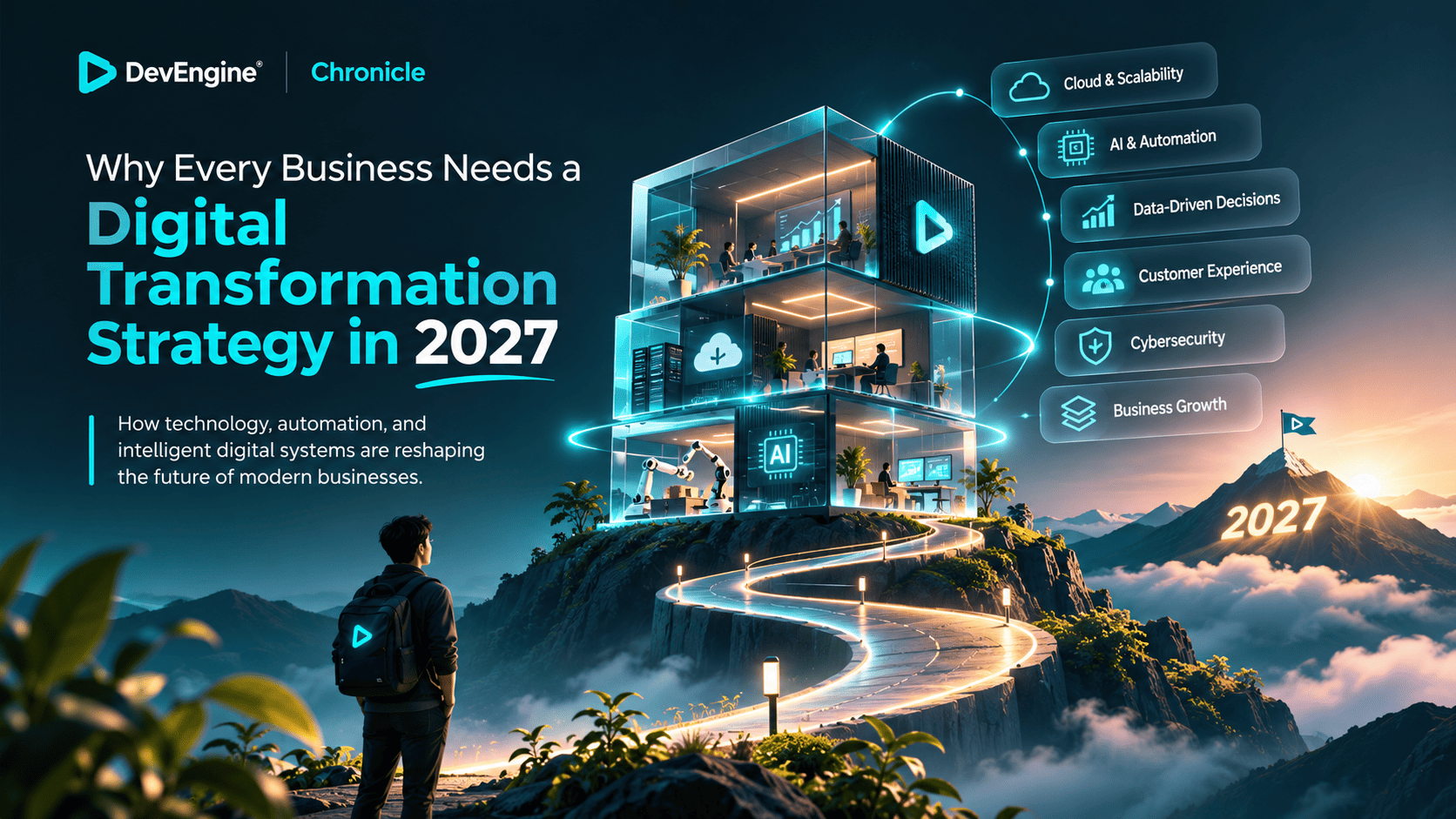
Why Every Business Needs a Digital Transformation Strategy in 2027
The way businesses operate is changing faster than ever. Customers expect smoother digital experiences, employees rely on connected tools, and organizations are under increasing pressure to operate efficiently while adapting to new opportunities.
Technology is no longer something businesses can consider separately from their everyday operations. It influences how companies communicate, manage information, deliver services, make decisions, and compete in their industries.
As we approach 2027, digital transformation is becoming an increasingly important business priority. However, successful transformation does not simply mean purchasing new software or moving existing processes online. It requires a clear strategy for using technology to create meaningful improvements.
For businesses of every size, the question is no longer whether digital transformation matters. The more important question is how to approach it effectively.
1. Digital Transformation Is More Than Adopting Technology
One common misunderstanding is that digital transformation means introducing a new application, purchasing management software, or creating a website.
Although these activities can contribute to transformation, the concept is much broader.
Digital transformation involves rethinking business processes, customer experiences, internal communication, and decision-making through the effective use of technology.
For example, a traditional business might manage customer information through spreadsheets, communicate through disconnected messaging platforms, and maintain financial records manually.
A more connected digital approach could introduce:
- A centralized customer relationship management system.
- Automated communication and follow-up workflows.
- Digital invoicing and financial management.
- Integrated reporting and analytics.
- Cloud-based collaboration tools.
The objective is not to use as many technologies as possible. It is to connect the right technologies to solve actual business problems.
2. Customer Expectations Are Becoming More Digital
Modern customers expect businesses to provide convenient, responsive, and consistent experiences.
They may want to discover products online, compare services, communicate with support teams, make payments, and receive updates without unnecessary delays.
When a business depends entirely on manual processes, delivering these experiences consistently can become difficult.
A thoughtful digital strategy helps organizations improve customer interactions through:
- Responsive websites and mobile applications.
- Online booking and purchasing experiences.
- Faster customer support.
- Personalized communication.
- Convenient digital payment options.
- Better access to information.
A business does not necessarily need an expensive digital platform to begin. Even a well-designed website, organized customer database, or reliable booking system can make a meaningful difference.
The important part is understanding what customers need and choosing technology that helps deliver it.
3. Automation Can Reduce Repetitive Work
Many organizations spend valuable time performing repetitive administrative tasks.
Examples include sending appointment reminders, preparing routine reports, updating records, processing internal requests, and following up with customers.
When these activities are handled entirely manually, employees have less time to focus on work that requires creativity, communication, and problem-solving.
Business automation can help streamline these processes.
For example:
- Automatically sending booking confirmations.
- Generating invoices after an approved transaction.
- Notifying employees about assigned tasks.
- Sending reminders before important deadlines.
- Synchronizing information between business systems.
Artificial intelligence can also support certain workflows, including information processing, content assistance, customer support, and data analysis.
However, automation should be implemented carefully. Businesses need to consider accuracy, privacy, security, and human oversight before automating important decisions.
The goal is not to replace every human interaction. It is to reduce unnecessary work and allow people to focus on higher-value activities.
4. Data-Driven Decisions Create Better Opportunities
Businesses generate information through sales, customer interactions, operations, marketing activities, and financial transactions.
However, collecting information is not the same as understanding it.
Without organized data, decision-makers may struggle to identify changing customer behavior, operational problems, or opportunities for improvement.
Digital systems can help bring business information together and make it easier to understand.
For example, a business dashboard could display:
- Monthly revenue.
- Sales performance.
- Customer acquisition.
- Product demand.
- Operational expenses.
- Customer retention.
- Employee productivity indicators.
These insights can help management make more informed decisions.
Instead of relying entirely on assumptions, businesses can examine available information, identify patterns, and evaluate whether their strategies are working.
A strong digital transformation strategy should therefore consider how business data is collected, protected, organized, and used.
5. Cloud Technology Makes Business Operations More Flexible
Traditional infrastructure can require significant upfront investment, maintenance, and technical management.
Cloud platforms offer another approach by allowing organizations to access computing resources, databases, storage, and applications through internet-based services.
Depending on the business requirements, cloud technology can support:
- Centralized data storage.
- Remote collaboration.
- Application hosting.
- Database management.
- Automated backups.
- Scalable infrastructure.
This can be particularly useful for growing businesses that need to expand their digital capabilities without managing every infrastructure component themselves.
However, moving to the cloud does not automatically guarantee better security or lower costs. Businesses must evaluate access controls, data protection, service reliability, backup strategies, and ongoing expenses.
The right cloud architecture should support the organization's actual requirements and future growth.
6. Cybersecurity Must Be Part of the Strategy
As businesses become more digitally connected, protecting information becomes increasingly important.
Customer records, financial information, employee accounts, and internal business documents can all become targets of unauthorized access or misuse.
Cybersecurity should not be treated as a final step after software development. It needs to be considered from the beginning.
Businesses should establish essential practices such as:
- Strong authentication and access controls.
- Multi-factor authentication where appropriate.
- Regular software updates.
- Secure data storage and transmission.
- Reliable backup and recovery procedures.
- Employee security awareness.
- Monitoring and incident response planning.
Organizations should also understand their responsibilities regarding customer privacy and applicable data protection requirements.
A digital business must be built not only for convenience and performance but also for trust.
7. Small Businesses Can Start Without Huge Budgets
Digital transformation is not limited to large enterprises with dedicated technology departments.
Small and medium-sized businesses can also benefit from practical digital improvements.
The most effective starting point is often a specific operational problem rather than a large technology investment.
For example:
A small retail business might begin by introducing a digital inventory management system.
A service provider might implement online appointment scheduling.
A growing company might adopt project management software to organize internal tasks.
An educational organization might introduce a digital learning platform.
These improvements can gradually create a more connected business environment.
A sensible approach is to start small, evaluate the results, and expand when there is a clear business reason to do so.
8. How to Build a Practical Digital Transformation Strategy
Successful transformation requires planning. Businesses should avoid adopting technologies simply because they are popular.
A practical strategy can begin with the following steps.
Step 1: Understand Existing Challenges
Evaluate current business operations and identify areas where manual processes, disconnected systems, or outdated workflows create difficulties.
Step 2: Define Clear Objectives
Determine what the business wants to improve.
Objectives might include reducing administrative workload, improving customer experience, increasing operational visibility, or making internal communication more efficient.
Step 3: Prioritize the Most Valuable Improvements
Not every process needs immediate transformation.
Identify the improvements that offer the greatest potential value relative to their cost, complexity, and implementation effort.
Step 4: Select Appropriate Technologies
Choose tools and platforms based on actual requirements.
Consider usability, integration capabilities, security, scalability, maintenance, and long-term ownership costs.
Step 5: Prepare Employees for Change
Technology adoption depends heavily on the people using it.
Provide appropriate training, explain the benefits, and involve employees in the transition.
Step 6: Measure Results
Establish measurable indicators before implementation.
Depending on the project, these might include processing time, customer response time, operational costs, error rates, or customer satisfaction.
Step 7: Improve Continuously
Digital transformation is not a one-time project.
Review performance, collect feedback, identify new challenges, and improve systems as the business evolves.
9. Common Digital Transformation Mistakes to Avoid
Even well-intentioned digital initiatives can fail when businesses overlook important considerations.
Some common mistakes include:
Adopting technology without a clear purpose: A new system should solve a defined problem rather than introduce unnecessary complexity.
Ignoring employee adoption: Even excellent software can become ineffective if employees do not understand how to use it.
Choosing tools without considering integration: Disconnected applications can create additional administrative work instead of reducing it.
Underestimating cybersecurity: Digital expansion without appropriate security practices can expose sensitive business information.
Expecting immediate results: Meaningful transformation requires planning, implementation, adaptation, and continuous improvement.
Ignoring long-term maintenance: Software requires updates, monitoring, support, and ongoing evaluation.
Avoiding these mistakes helps businesses approach digital transformation as a structured business initiative rather than an isolated technology purchase.
10. Preparing Your Business for 2027 and Beyond
The future of business will continue to be influenced by artificial intelligence, automation, cloud computing, connected platforms, and evolving customer expectations.
However, the organizations that benefit most will not necessarily be those adopting the greatest number of technologies.
They will be the organizations that understand their challenges, choose appropriate solutions, and use technology with a clear purpose.
A business that builds a strong digital foundation today can become better prepared to respond to tomorrow's opportunities.
The process does not need to happen all at once. Small, carefully planned improvements can create meaningful progress over time.
Final Thoughts
Digital transformation is ultimately about improving the way a business works.
It connects technology with people, processes, customer experiences, and long-term business objectives.
As 2027 approaches, businesses should look beyond individual software tools and begin thinking about how their entire digital environment supports their goals.
Whether it involves introducing automation, developing custom software, improving customer experiences, or modernizing existing systems, every transformation should begin with a clear understanding of the problem it is intended to solve.
At DevEngine, we believe technology creates the greatest value when it is designed around real-world needs. Building the right digital foundation today can help businesses move forward with greater confidence, flexibility, and opportunity.
The future belongs not simply to businesses that use technology, but to businesses that use it with purpose.
DevEngine — Engineering Ideas Into Digital Possibilities.