
What Comes Next: Building DevEngine for the Long Run
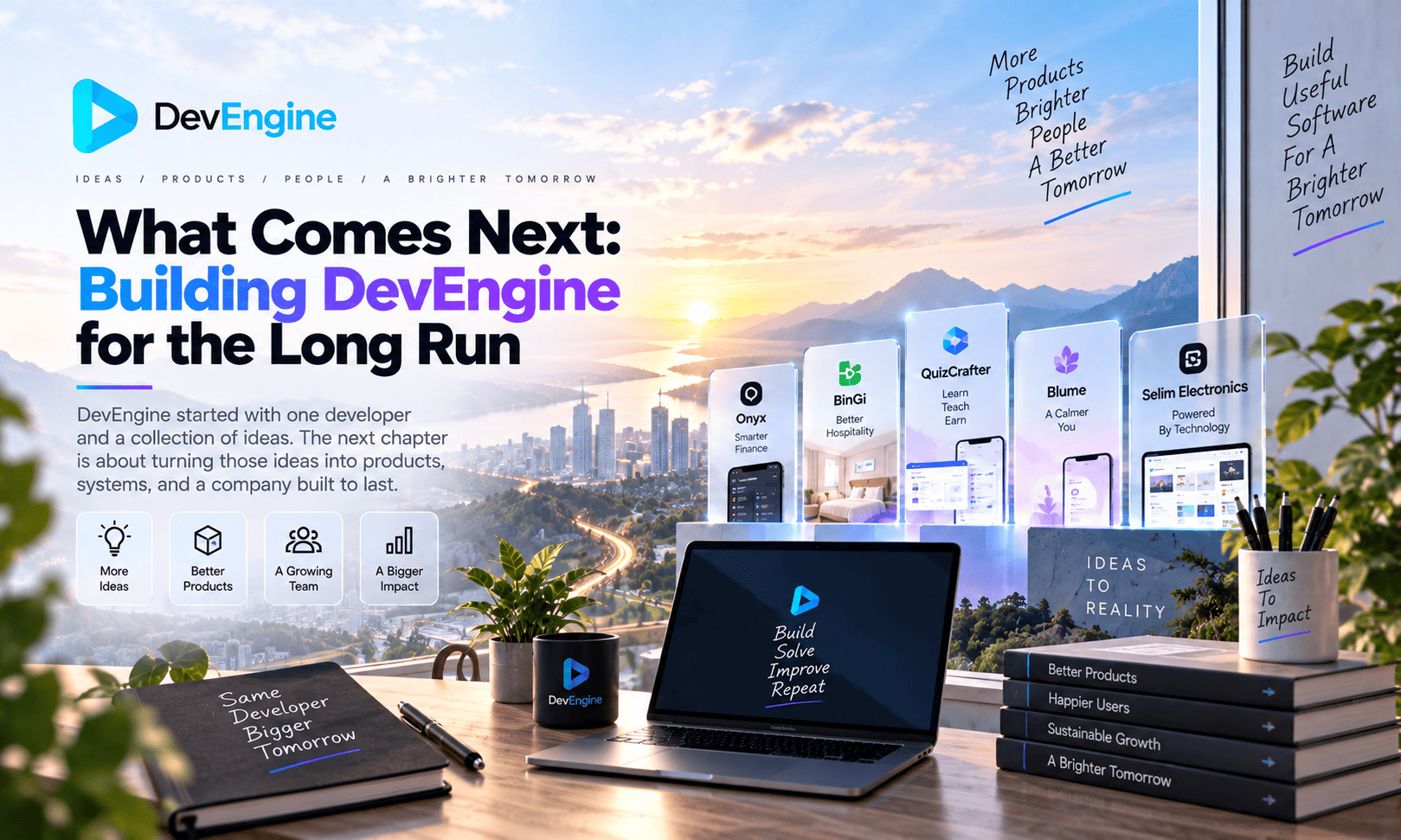
DevEngine started with one developer and a collection of ideas. The next chapter is about turning those ideas into products, systems, and a company built to last.

What Comes Next: Building DevEngine for the Long Run
There is something strange about building a company from zero.
For a long time, everything feels temporary.
The first project is temporary.
The first design is temporary.
The first website is temporary.
The first architecture changes.
The first plan changes.
Even the definition of the company changes.
You are constantly building something while simultaneously figuring out what you are actually building.
That is where DevEngine is today.
Still building.
Still learning.
Still changing.
But with a much clearer idea of where we want to go.
It Started With One Developer
DevEngine didn't begin with a large team.
It didn't begin with a huge infrastructure.
It didn't begin with dozens of products.
It started small.
One developer.
One computer.
A lot of ideas.
A lot of uncertainty.
And a simple belief:
Good software can turn good ideas into real possibilities.
Everything since then has grown from that belief.
The First Goal Was Simply to Build
At the beginning, the goal was straightforward.
Learn.
Build projects.
Solve problems.
Become better at software development.
But building repeatedly changes the way you think.
You begin to notice patterns.
You understand why certain decisions cause problems.
You recognize where projects usually become complicated.
You learn what users actually care about.
You start thinking beyond individual features.
Eventually, you stop asking only:
"Can I build this?"
And start asking:
"Should this exist?"
"Who does it help?"
"How should it work?"
"How can it become something bigger?"
That shift is where DevEngine began becoming more than a development project.
From Projects to Products
There is a difference between building software and building products.
A project can have a beginning and an end.
A product has a life.
It needs users.
It needs maintenance.
It needs updates.
It needs feedback.
It needs infrastructure.
It needs a reason to continue existing.
That's the direction we want DevEngine to move toward.
Not simply producing applications.
Building products that can continue growing after the first release.
We Don't Know Everything Yet
And that's okay.
There are technologies we haven't mastered.
Problems we haven't encountered.
Markets we haven't explored.
Products we haven't imagined.
There are mistakes we haven't made yet.
The goal isn't to pretend we already know everything.
The goal is to build a company capable of learning.
That matters more.
Because the technology landscape will continue changing.
The tools we use today won't be the same forever.
The way software is built will evolve.
AI will change workflows.
Cloud infrastructure will evolve.
User expectations will change.
New platforms will appear.
A company that depends on one technology or one process can't remain flexible forever.
Build the Foundation, Then Keep Improving It
One thing we have learned is that foundations matter.
Good architecture matters.
Clear design systems matter.
Reliable deployment matters.
Security matters.
Documentation matters.
Testing matters.
But foundations aren't supposed to prevent change.
They should make change easier.
The goal isn't to build something that never needs to change.
The goal is to build something that can change without falling apart.
That principle applies to software.
And it applies to DevEngine itself.
The Products Will Change
Some of the products we build today may become something completely different tomorrow.
Some ideas may grow.
Some may stop.
Some may become internal tools.
Some may become independent products.
Some may teach us something important and then disappear.
That's normal.
Not every experiment needs to become a company.
Not every project needs to become a startup.
Sometimes the value of a project is what it teaches you.
And sometimes an experiment unexpectedly becomes something much bigger.
We want to leave room for both possibilities.
The Company Will Change Too
DevEngine today is not the DevEngine of the future.
The team may grow.
The responsibilities will change.
The systems will become more mature.
The products will become more ambitious.
The way we work will evolve.
There will be new people bringing new ideas.
New perspectives will challenge old assumptions.
That's healthy.
A company should not be designed around one person's current knowledge.
It should create an environment where knowledge can grow beyond the people who started it.
What We Want to Build
The long-term vision isn't simply:
"Build more software."
That's too easy.
We want to build useful software.
Products that solve real problems.
Tools that make complicated processes easier.
Systems that businesses can depend on.
Experiences that people understand without needing a manual.
And technology that creates measurable value rather than simply looking impressive.
That is a much harder goal.
And that's exactly why it is worth pursuing.
Quality Over Noise
The software industry can be incredibly loud.
New tools.
New frameworks.
New announcements.
New trends.
New buzzwords.
New promises.
It can become easy to confuse activity with progress.
We don't want DevEngine to be defined by how much noise it creates.
We want the work to speak.
A useful product.
A reliable system.
A thoughtful interface.
A well-engineered platform.
A happy customer.
Those things matter more than simply being visible.
We Want to Stay Curious
Curiosity is one of the most valuable things a developer can have.
Why does this work?
Why doesn't this work?
Could this be simpler?
Could this be faster?
Could this be safer?
Could this experience be better?
What happens if we try something completely different?
That curiosity is what keeps development interesting.
And it is something we want to preserve as DevEngine grows.
AI Will Change How We Build
Software development is already changing.
AI-assisted development is becoming increasingly capable.
Tools can help generate code.
Analyze problems.
Explain unfamiliar systems.
Create prototypes.
Automate repetitive tasks.
Help developers move faster.
But faster development doesn't remove the need for engineering judgment.
If anything, it makes judgment more important.
When creating software becomes easier, deciding what should be created becomes even more important.
AI can accelerate the process.
Humans still need to define the purpose.
The Future Isn't About One Technology
We don't know exactly which frameworks will dominate the next few years.
And we don't need to.
The future of DevEngine shouldn't depend on one framework.
It should depend on our ability to learn.
If a better technology appears, we'll evaluate it.
If an existing technology remains the right choice, we'll keep using it.
If a system needs to be rebuilt, we'll rebuild it.
The tools can change.
The mindset remains.
Understand.
Build.
Measure.
Learn.
Improve.
From Developer to Company
There is another transition happening quietly.
The goal is no longer only to become a better developer.
It is to build an organization capable of producing good software consistently.
That means learning about:
- Product development
- Design systems
- Engineering processes
- Project management
- Customer relationships
- Documentation
- Business operations
- Team building
- Quality standards
- Long-term strategy
Writing code is still important.
But building a software company requires much more than code.
The Hard Part Is Staying Consistent
Starting something is exciting.
Keeping it alive is harder.
Anyone can have an idea.
The difficult part is continuing after the excitement disappears.
Continue when a project fails.
Continue when the first version isn't good enough.
Continue when growth is slow.
Continue when the technology changes.
Continue when the original plan stops working.
Consistency is not glamorous.
But companies are built through it.
There Will Be More Failed Experiments
Some future ideas won't work.
Some products won't find the audience we expected.
Some technical decisions will eventually need to be replaced.
Some projects will take longer than planned.
Some launches won't go perfectly.
That's part of the process.
The objective isn't to eliminate failure.
It's to make sure every failure leaves the company smarter.
A failed experiment should improve the next experiment.
A difficult project should improve the next process.
A technical mistake should improve the next architecture.
That is how experience compounds.
There Will Also Be Things That Work
And that's the exciting part.
Some ideas will work.
Some products will find users.
Some systems will grow.
Some projects will become much bigger than originally expected.
Some things we haven't even imagined yet will become part of DevEngine's story.
Those possibilities are why we keep building.
The Chronicle Is Part of the Journey
This Chronicle is more than a collection of articles.
It is a record.
A snapshot of how DevEngine thinks at this stage.
The early experiments.
The failures.
The engineering lessons.
The design philosophy.
The technologies.
The products.
The ambitions.
Years from now, some of these ideas may look different.
That's okay.
In fact, that would mean we've grown.
The Chronicle will change as the company changes.
This Is Only Volume One
There is still so much left to build.
More products.
More experiments.
More engineering problems.
More lessons.
More people.
More ideas.
More mistakes.
More releases.
More stories.
These ten articles are not a conclusion.
They're a beginning.
A first record of what it looked like to build DevEngine from the ground up.
What Comes Next
The next chapter isn't completely written.
And maybe that's the best part.
We know the direction.
We know the principles.
We know the kind of products we want to create.
But there is still room for discovery.
The roadmap will change.
The technology will change.
The products will change.
We will change.
And we'll keep building through all of it.
Keep Building
If there is one idea that connects everything in the DevEngine story, it is this:
Keep building.
When the first version fails, build again.
When the architecture becomes difficult, improve it.
When the technology changes, learn.
When users give feedback, listen.
When an idea isn't good enough, change it.
When something works, make it better.
There is always another version.
From One Developer to Whatever Comes Next
DevEngine started with one developer.
Where it goes from here is still being written.
Maybe one day there will be a much larger team.
Maybe there will be products used by thousands or millions of people.
Maybe there will be technologies we haven't even heard of yet.
Maybe some of today's projects will become something completely unexpected.
We don't know.
And that's okay.
Because the goal was never to know everything from the beginning.
The goal was to start.
Then learn.
Then build.
Then keep going.
The Work Continues
There is no perfect ending to a company story.
Especially when the company is still being built.
So this isn't an ending.
It's a checkpoint.
A moment to look back at how far the journey has come.
And then look forward.
There is more to learn.
More to build.
More to improve.
More problems worth solving.
More ideas waiting to become real.
The next chapter starts the same way the first one did.
With an idea.
And someone willing to build it.
DevEngine is still building.
And this is only the beginning.
If you are looking for an engineering partner for your next build, start a conversation with us.