
The Power of API-First Development in Modern Software
How API-first architecture helps businesses build connected, scalable, and flexible digital products.

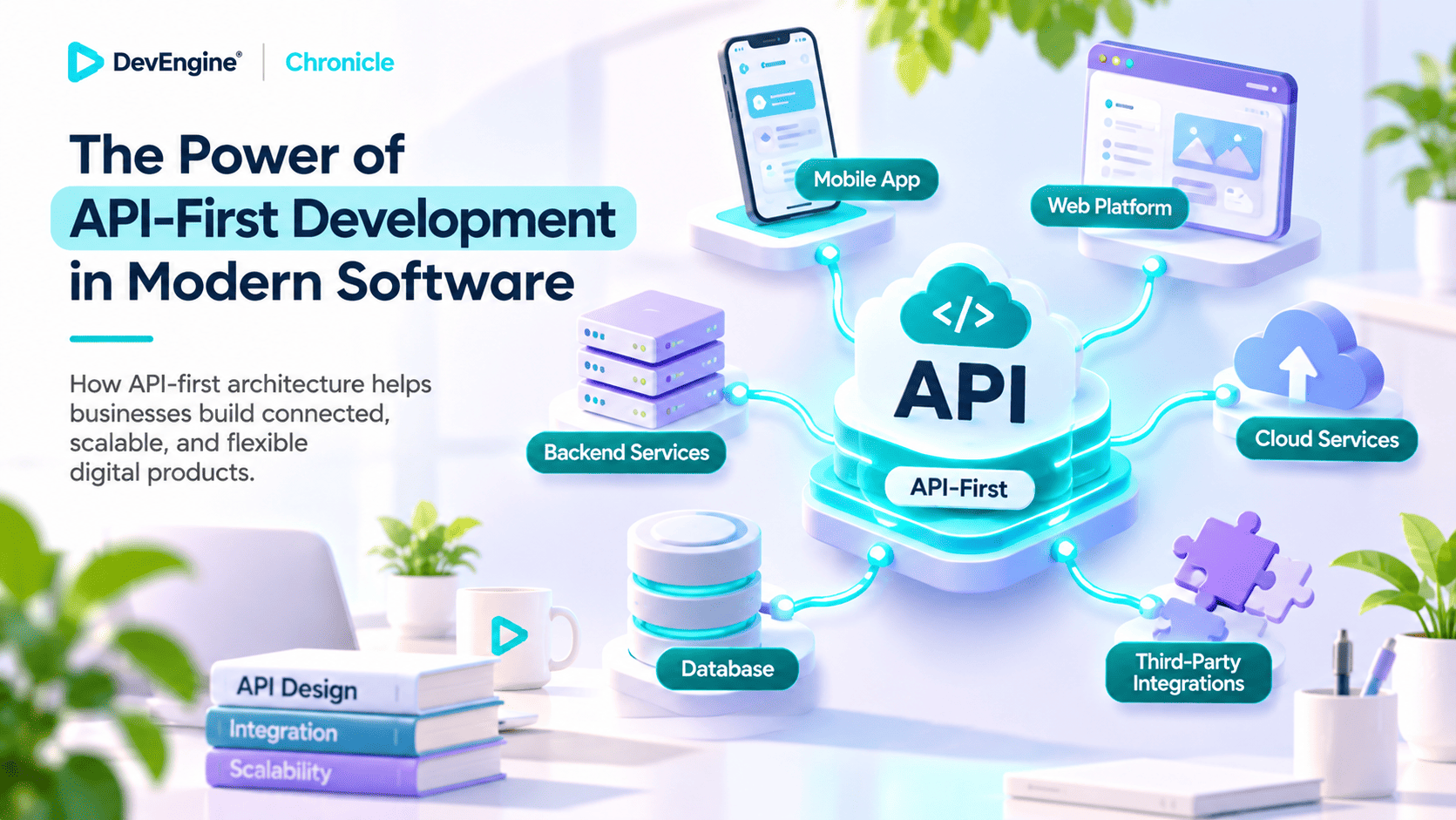
The Power of API-First Development in Modern Software
Modern software rarely exists as a single independent application.
A mobile app may communicate with a backend server, retrieve information from a database, process payments through an external provider, and synchronize information with a web platform. A business dashboard may depend on several services working together to deliver a consistent experience.
Behind many of these interactions is a technology that makes modern digital ecosystems possible: the Application Programming Interface, commonly known as an API.
As software products become more connected, the way development teams design and build these integrations becomes increasingly important.
This is where API-first development comes into the picture.
Rather than treating APIs as something created after an application is developed, API-first development makes the API contract an early foundation of the software architecture.
It helps teams build systems that are easier to integrate, maintain, extend, and evolve.
1. Understanding What an API Actually Does
An API is a defined way for different software systems to communicate with each other.
It specifies how one application can request information or functionality from another system and what response it can expect.
Consider a simple example.
A mobile application displays a user's profile information. Instead of accessing the database directly, the application sends a request to a backend API.
The backend processes the request, retrieves the appropriate information, and returns a structured response.
The mobile application then uses that response to display the profile.
This separation allows the mobile application and backend to operate independently while communicating through a defined interface.
APIs are commonly used for:
- User authentication and authorization.
- Retrieving and updating application data.
- Payment processing.
- File uploads and downloads.
- Notifications and messaging.
- Third-party service integrations.
- Communication between internal software services.
In modern development, APIs are not simply technical connections. They are important building blocks of a product's architecture.
2. What Is API-First Development?
API-first development is an approach where teams design and define the APIs before building the applications or services that consume them.
In a traditional development workflow, a team might begin by implementing the backend and then create endpoints as the frontend requirements become clearer.
This can work for small projects, but it may introduce communication problems when multiple teams or platforms depend on the same backend.
API-first development changes the sequence.
The team first defines how different parts of the system will communicate.
This includes:
- Available endpoints and operations.
- Request and response structures.
- Authentication requirements.
- Data types and validation rules.
- Error responses.
- Versioning expectations.
- Documentation and usage examples.
Once the contract is agreed upon, frontend and backend developers can work against the same specification.
The result is a more coordinated development process with fewer assumptions about how the system should behave.
3. Why API-First Development Matters for Modern Products
A digital product may begin with a single application, but its requirements can grow over time.
A business might initially launch a web platform and later introduce a mobile application, an administrative dashboard, a partner portal, or integrations with external services.
If every application implements its own independent backend logic, maintaining consistency becomes difficult.
An API-first architecture helps establish a shared communication layer.
For example, the same backend API can support:
- A Flutter mobile application.
- A Next.js web application.
- An administrative dashboard.
- A partner integration.
- An internal reporting system.
Each client can use the same documented business operations without duplicating the entire backend.
This makes it easier to introduce new platforms while keeping core business logic centralized.
4. API Contracts Improve Frontend and Backend Collaboration
One of the biggest challenges in software development is coordinating work across different teams.
Frontend developers may need to know what data an endpoint returns, while backend developers may need to understand how the frontend expects to use that information.
Without a shared specification, misunderstandings can lead to inconsistent implementations and unnecessary rework.
API contracts help solve this problem.
An API contract defines the expected communication between a client and a service.
For example, a user profile endpoint might return a response with fields such as:
- User ID.
- Full name.
- Email address.
- Profile image.
- Account status.
The frontend team can build its interface against this structure while the backend team implements the corresponding functionality.
Mock responses and tools such as OpenAPI can also help developers test and explore endpoints before the complete backend implementation is available.
This encourages parallel development and makes integration more predictable.
5. REST, GraphQL, and Other API Approaches
Not every API needs to follow the same architectural style.
Different communication requirements may benefit from different approaches.
REST APIs
REST is a widely used architectural style for building web APIs.
It commonly uses HTTP methods such as:
- GET to retrieve resources.
- POST to create resources or trigger operations.
- PUT or PATCH to update resources.
- DELETE to remove resources.
REST APIs often organize functionality around resource-oriented URLs.
For example:
GET /api/products
GET /api/products/123
POST /api/products
REST is popular because it is widely understood, works naturally with HTTP infrastructure, and is supported by many development tools.
GraphQL
GraphQL provides a query language and runtime that allows clients to request specific data through a defined schema.
Instead of relying on multiple resource endpoints for every data requirement, a client can request the fields it needs through a GraphQL query.
This can be useful when applications have complex data relationships or different clients require different response shapes.
However, GraphQL also introduces considerations around query complexity, caching, authorization, and server-side performance.
WebSockets
WebSockets provide a persistent, bidirectional communication channel between clients and servers.
They are useful when applications need real-time communication, such as:
- Live chat.
- Real-time dashboards.
- Collaborative applications.
- Live notifications.
- Multiplayer experiences.
These technologies serve different purposes. The right choice depends on the product's requirements rather than popularity alone.
6. API-First Architecture Makes Multi-Platform Development Easier
Many modern businesses need to deliver experiences across multiple platforms.
A customer might use a mobile application, while an employee manages the same information through an administrative web dashboard.
An API-first architecture helps these applications share backend capabilities.
Consider a hotel management platform.
Its ecosystem might contain:
- A guest mobile application.
- A hotel staff application.
- A management dashboard.
- A booking website.
- Payment provider integrations.
Instead of creating separate business logic for each platform, these clients can communicate with a shared backend through documented APIs.
For example, a reservation created through the guest application can become available to authorized staff through the management dashboard.
This creates a more consistent digital environment.
It also makes it easier to introduce new clients without rebuilding existing business functionality.
7. Security Must Be Designed Into APIs
APIs often provide access to important business information and operations.
This makes API security an essential part of system design.
A poorly secured endpoint can expose private information, allow unauthorized actions, or create opportunities for abuse.
Development teams should consider several important practices.
Authentication
Authentication verifies the identity of the user or system making a request.
Depending on the architecture, this may involve secure sessions, access tokens, or other identity mechanisms.
Authorization
Authentication alone is not enough.
Authorization determines what an authenticated user is allowed to access or modify.
For example, an ordinary customer should not be able to access administrative operations simply because they have a valid account.
Input Validation
API requests should be validated on the server.
Never assume that data received from a client is safe or correctly formatted.
Rate Limiting
Rate limiting helps control excessive requests and reduce the risk of abuse.
Secure Communication
Sensitive API traffic should use HTTPS to protect information while it travels between systems.
Monitoring and Logging
Teams should monitor important API activity, identify unusual behavior, and maintain appropriate logs without unnecessarily exposing sensitive information.
Security should be part of the API contract and implementation from the beginning.
8. Documentation Is a Core Part of API Development
An API can be technically powerful but difficult to use if developers do not understand how it works.
Good documentation reduces that friction.
It should explain:
- What each endpoint does.
- Which HTTP methods are supported.
- Required parameters.
- Request and response examples.
- Authentication requirements.
- Possible error responses.
- Rate limits and usage restrictions.
- Versioning and compatibility expectations.
Tools such as OpenAPI can describe HTTP API structures in a standardized format.
Swagger UI and similar tools can turn API specifications into interactive documentation.
This allows developers to explore endpoints, inspect schemas, and understand expected behavior.
Documentation should evolve alongside the API. Outdated documentation can be just as problematic as having no documentation at all.
9. API Versioning Helps Software Evolve Safely
Software requirements change.
A business may introduce new fields, modify response structures, improve authentication, or change how a service behaves.
However, existing applications may still depend on the previous API contract.
Changing an API without considering existing consumers can break applications that are already in production.
Versioning provides a way to manage these changes.
For example:
/api/v1/products
/api/v2/products
A new version can introduce significant changes while allowing older clients to continue using the previous contract during a planned transition.
Not every API change requires a new major version.
Backward-compatible improvements can often be introduced without disrupting existing clients.
The important part is to establish clear compatibility rules and communicate breaking changes before they affect consumers.
10. Common API-First Development Mistakes
API-first development offers important advantages, but it can still fail when teams approach it incorrectly.
Some common mistakes include:
Designing APIs without understanding actual use cases: Endpoints should support real product requirements rather than exist simply to expose database tables.
Overcomplicating the API structure: Excessively complicated contracts can make integration and maintenance harder.
Ignoring security requirements: Authentication, authorization, validation, and access control must be considered from the beginning.
Treating documentation as optional: Developers need reliable information about how an API behaves.
Changing contracts without considering existing clients: Breaking changes should be planned and communicated.
Duplicating business logic across clients: Important business rules should generally remain within trusted backend services rather than being independently implemented in every application.
Avoiding these mistakes helps create APIs that are easier to understand, maintain, and extend.
11. How to Start Building an API-First Product
Teams can introduce API-first development through a practical process.
Step 1: Understand the Product Requirements
Identify the applications, users, services, and business operations that need to communicate.
Step 2: Define the API Boundaries
Determine which capabilities belong to the backend and which responsibilities belong to individual clients.
Step 3: Design the API Contract
Specify endpoints, request structures, response formats, authentication requirements, and error handling.
Step 4: Document the Specification
Use a suitable specification format, such as OpenAPI for HTTP APIs, so developers have a shared reference.
Step 5: Build Mock Responses
Allow frontend teams to begin implementation before every backend service is complete.
Step 6: Implement and Validate
Build the backend against the agreed contract and verify that actual responses match the documented behavior.
Step 7: Monitor and Improve
Observe API performance, errors, usage patterns, and integration feedback.
Improve the contract carefully as the product evolves.
12. The Future of Connected Software
Digital products are becoming increasingly interconnected.
Mobile applications, web platforms, cloud services, intelligent systems, and external providers are expected to work together as parts of larger digital ecosystems.
APIs make these connections possible.
As organizations build more complex products, well-designed APIs can help them introduce new capabilities without unnecessarily rebuilding existing systems.
API-first development also encourages teams to think beyond individual screens or applications.
Instead, they design reusable capabilities that can support multiple products and experiences.
This creates a foundation for more flexible software development.
Final Thoughts
API-first development is more than a backend engineering preference. It is a way of designing software around clear communication, shared contracts, and long-term flexibility.
By defining APIs early, documenting them properly, and considering security and compatibility from the beginning, development teams can build systems that are easier to integrate and evolve.
Whether a product consists of a mobile application, a web platform, or a large collection of connected services, a thoughtful API strategy can make a significant difference.
At DevEngine, we believe strong software architecture begins with clear engineering decisions. Building reliable connections between systems helps transform individual applications into scalable digital ecosystems.
Great software is not only about what each application can do. It is also about how effectively different systems work together.
DevEngine — Engineering Ideas Into Digital Possibilities.