
Shipping Is Harder Than Coding: What Nobody Tells You About Building Software
Writing the feature is only one part of the job. Getting reliable software into the hands of real users is where the real work begins.

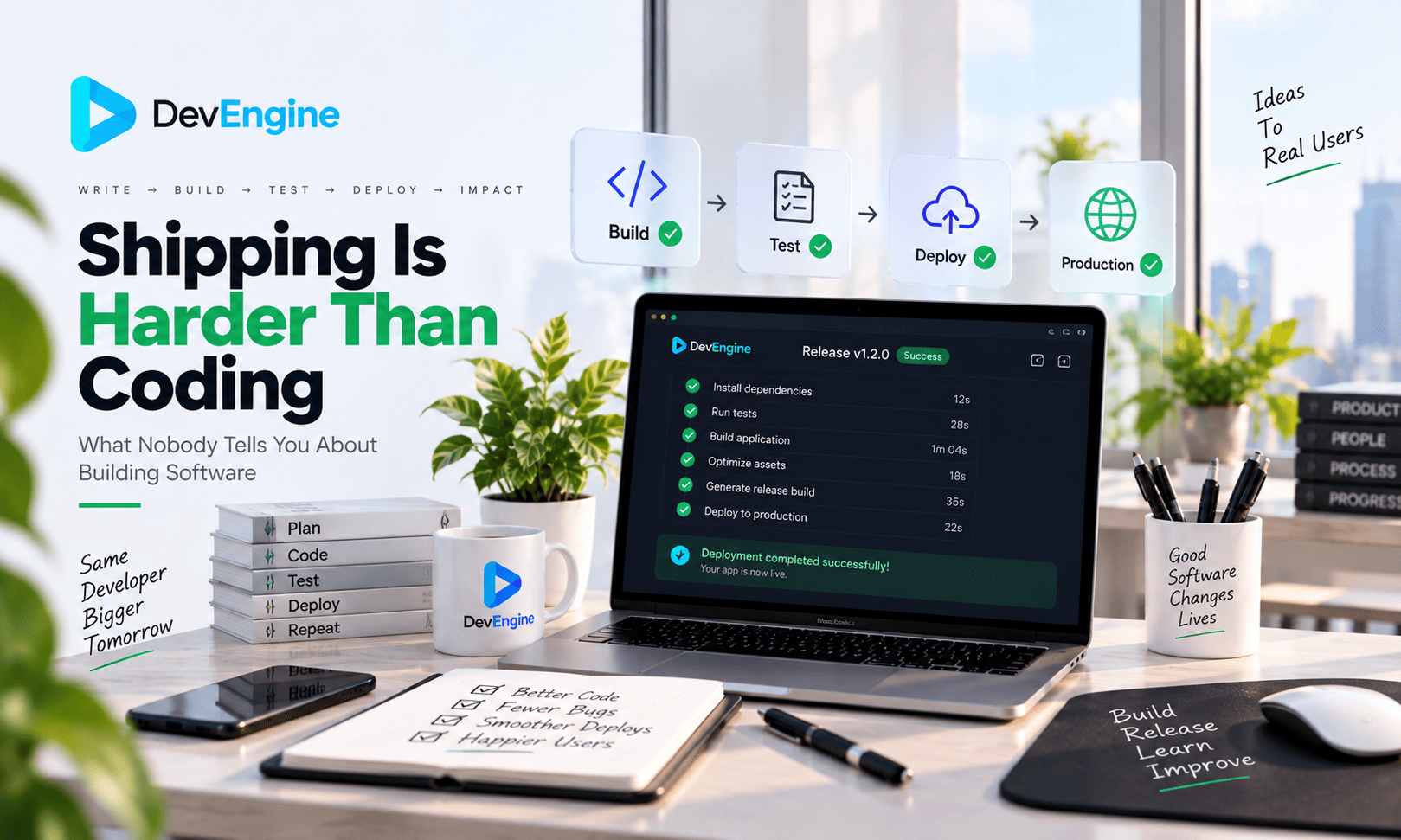
Shipping Is Harder Than Coding: What Nobody Tells You About Building Software
There is a satisfying moment in development when a feature finally works.
The button responds.
The data loads.
The screen looks right.
The error is gone.
You think:
"Done."
Then comes the next part.
Build it.
Test it.
Configure it.
Sign it.
Deploy it.
Monitor it.
And hope nothing unexpected happens.
Because writing software and shipping software are two different problems.
"It Works on My Machine"
Every developer knows this sentence.
The application works locally.
The database responds.
The API works.
Everything looks good.
Then the production build arrives.
Suddenly something is different.
An environment variable is missing.
A permission is wrong.
A package behaves differently.
A build configuration causes an error.
An API endpoint isn't configured correctly.
The application crashes somewhere that never happened during development.
The code wasn't necessarily wrong.
The environment was different.
That's why production needs to be treated as part of the engineering process, not as the final button we press after development.
Shipping Has Many Layers
Getting an application into a user's hands involves much more than writing features.
There is:
- Code
- Configuration
- Authentication
- Security
- Database rules
- API configuration
- Build systems
- Signing
- Testing
- Monitoring
- Store requirements
- Version management
- Deployment
Each layer can introduce its own failure.
And sometimes the smallest configuration mistake can block the entire release.
The First Release Is a Different Kind of Test
Development tells us:
"Does this work?"
Production asks:
"Does this continue working when real people use it?"
That's a much harder question.
Real users have different devices.
Different network speeds.
Different behaviors.
Different expectations.
They tap things in unexpected orders.
They enter data we never imagined.
They discover edge cases we didn't test.
And sometimes they find a problem within minutes that we never found after hours of testing.
That's not necessarily a failure of development.
It's information.
Deployment Is Engineering Too
For a long time, it's easy to think of deployment as something separate from development.
Write the code first.
Deploy later.
But the earlier deployment is considered, the fewer surprises appear at the end.
How will the application be configured?
Where will the data live?
How will errors be monitored?
How will a new version be released?
How will we roll forward after a problem?
How will users receive updates?
These questions belong in the development conversation.
The Invisible Work
Some of the most important engineering work is invisible to users.
A user doesn't see:
A carefully configured CI/CD pipeline.
A secure database rule.
A crash-reporting system.
A properly signed build.
A reliable deployment process.
A carefully handled environment variable.
A tested rollback strategy.
But they benefit from all of them.
Good infrastructure often feels invisible when it works.
That's the point.
Shipping Changes Your Definition of "Done"
Before production, "done" can mean:
"The feature works."
After working with real products, the definition becomes larger.
Done means:
The feature works.
The failure cases are handled.
The data is protected.
The build can be released.
The application behaves correctly in production.
The important workflows have been tested.
Errors can be observed.
Users can recover when something goes wrong.
That is a much higher standard.
And it should be.
Sometimes You Just Have to Ship
There is another lesson here.
If we wait for software to become perfect, it may never leave development.
There will always be another improvement.
Another animation.
Another optimization.
Another feature.
Another refactor.
At some point, the product needs to meet reality.
Ship carefully.
Watch closely.
Learn.
Then improve.
That is often more valuable than spending months trying to predict every possible problem before releasing anything.
The Real Finish Line
The finish line isn't when the last line of code is written.
It isn't when the design is approved.
It isn't even when the build succeeds.
The real milestone is when the software can reliably do its job for the people who need it.
And even then, the work continues.
Because once software is in the real world, we finally have something that development alone cannot provide:
evidence.
Evidence of what works.
Evidence of what doesn't.
Evidence of what users need next.
That's why shipping isn't the end of software development.
It's the beginning of the next version.
Keep Shipping
The more software we build, the more we learn that shipping is its own engineering discipline.
Code gets the product moving.
Engineering gets it ready.
Deployment gets it into the world.
Real users tell us what comes next.
And the cycle continues.
Build.
Test.
Ship.
Learn.
Improve.
Repeat.
For teams looking to establish robust cloud pipelines and deployment workflows, see our cloud infrastructure solutions.