
How to Choose the Right Technology Stack for Your Business
A practical guide to selecting technologies that support your business goals, performance, and long-term growth.

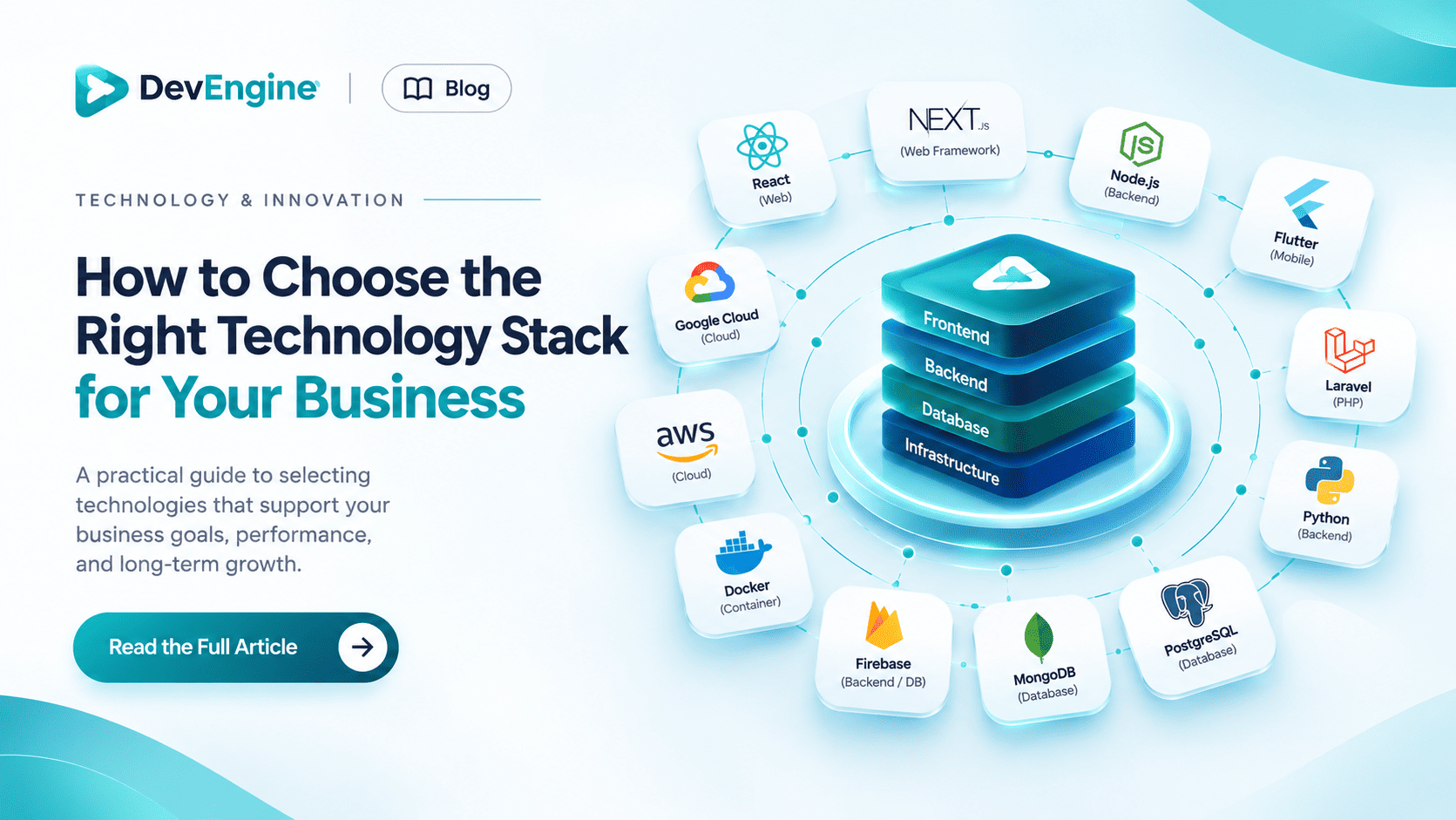
How to Choose the Right Technology Stack for Your Business
Building a digital product requires more than just a great idea. The technologies behind it play a major role in determining its performance, security, scalability, and long-term maintenance.
A technology stack is the combination of programming languages, frameworks, databases, development tools, and infrastructure used to build and operate a software application.
Choosing the right stack can help businesses reduce development costs, improve user experiences, and prepare their products for future growth.
Here are seven important factors to consider before making that decision.
1. Understand Your Business Requirements
Before selecting any technology, identify what your business actually needs.
A simple company website, an eCommerce platform, and a complex enterprise management system have very different technical requirements.
Consider:
- What problem will the software solve?
- Who will use the application?
- Does it require web, mobile, or both platforms?
- Will it process payments or sensitive information?
- What features are essential for the first release?
The technology should support your business objectives rather than complicate them.
2. Evaluate Performance and Scalability
Your application should perform reliably as the number of users, transactions, and data increases.
A solution that works perfectly for 100 users may struggle when the platform grows to 100,000 users.
Consider technologies that support:
- Efficient database queries.
- Caching and optimized API communication.
- Load balancing and horizontal scaling.
- Background processing for heavy operations.
- Reliable infrastructure and monitoring.
Planning for scalability early can prevent expensive architectural changes later.
3. Choose Technologies Based on the Product Type
Different products benefit from different technologies.
For example:
- Web Applications: React, Next.js, Vue.js, and other modern web frameworks.
- Mobile Applications: Flutter, React Native, Kotlin, and Swift.
- Backend Development: Node.js, Laravel, Django, and Spring Boot.
- Databases: PostgreSQL, MySQL, MongoDB, and Firebase.
- Cloud Infrastructure: AWS, Google Cloud, Microsoft Azure, and other hosting platforms.
These are examples, not universal recommendations. The best combination depends on the product's requirements and development environment.
4. Consider Development and Maintenance Costs
Technology decisions affect both initial development costs and ongoing operational expenses.
Some platforms may offer faster development, while others may require specialized developers or additional infrastructure.
Evaluate:
- Development time and complexity.
- Hosting and infrastructure expenses.
- Third-party service costs.
- Developer availability.
- Maintenance and upgrade requirements.
A technology stack should be financially sustainable, not just attractive during the initial development phase.
5. Prioritize Security and Data Protection
Security should never be treated as an optional feature.
Applications often handle personal information, business records, financial transactions, and confidential data.
Your technology stack should support:
- Secure authentication and authorization.
- Data encryption during transmission and storage.
- Proper API access controls.
- Regular dependency updates.
- Database security and backup strategies.
- Monitoring and security auditing.
The right architecture helps reduce security risks while protecting user trust.
6. Check Community Support and Ecosystem
A technology may look promising, but limited documentation and community support can make development and maintenance difficult.
Before choosing a framework or platform, evaluate its ecosystem.
Look for:
- Reliable documentation.
- Active development and updates.
- Available libraries and integrations.
- Developer community support.
- Long-term compatibility and stability.
A mature ecosystem can help teams solve problems faster and maintain applications more efficiently.
7. Build for Long-Term Flexibility
Business requirements change. New features, integrations, platforms, and customer expectations may emerge over time.
Your architecture should make future improvements manageable.
Consider:
- Modular and maintainable code structures.
- Well-defined APIs and service boundaries.
- Database migration strategies.
- Automated testing and deployment.
- Clear technical documentation.
- The ability to integrate new services when needed.
Avoid unnecessary complexity at the beginning. Build what the business needs today while keeping a sensible path open for tomorrow.
Final Thoughts
Choosing the right technology stack is not about selecting the most popular programming language or the newest framework.
It is about finding the right balance between business requirements, performance, security, development costs, and long-term maintainability.
A well-planned technology foundation allows businesses to build digital products that are reliable today and adaptable for the future.
At DevEngine, we believe great software starts with the right technical decisions and grows through thoughtful engineering.
Build. Deploy. Grow.