
How AI and Business Automation Are Changing the Way Companies Work
Discover how artificial intelligence and intelligent automation are transforming business operations, productivity, and customer experiences.

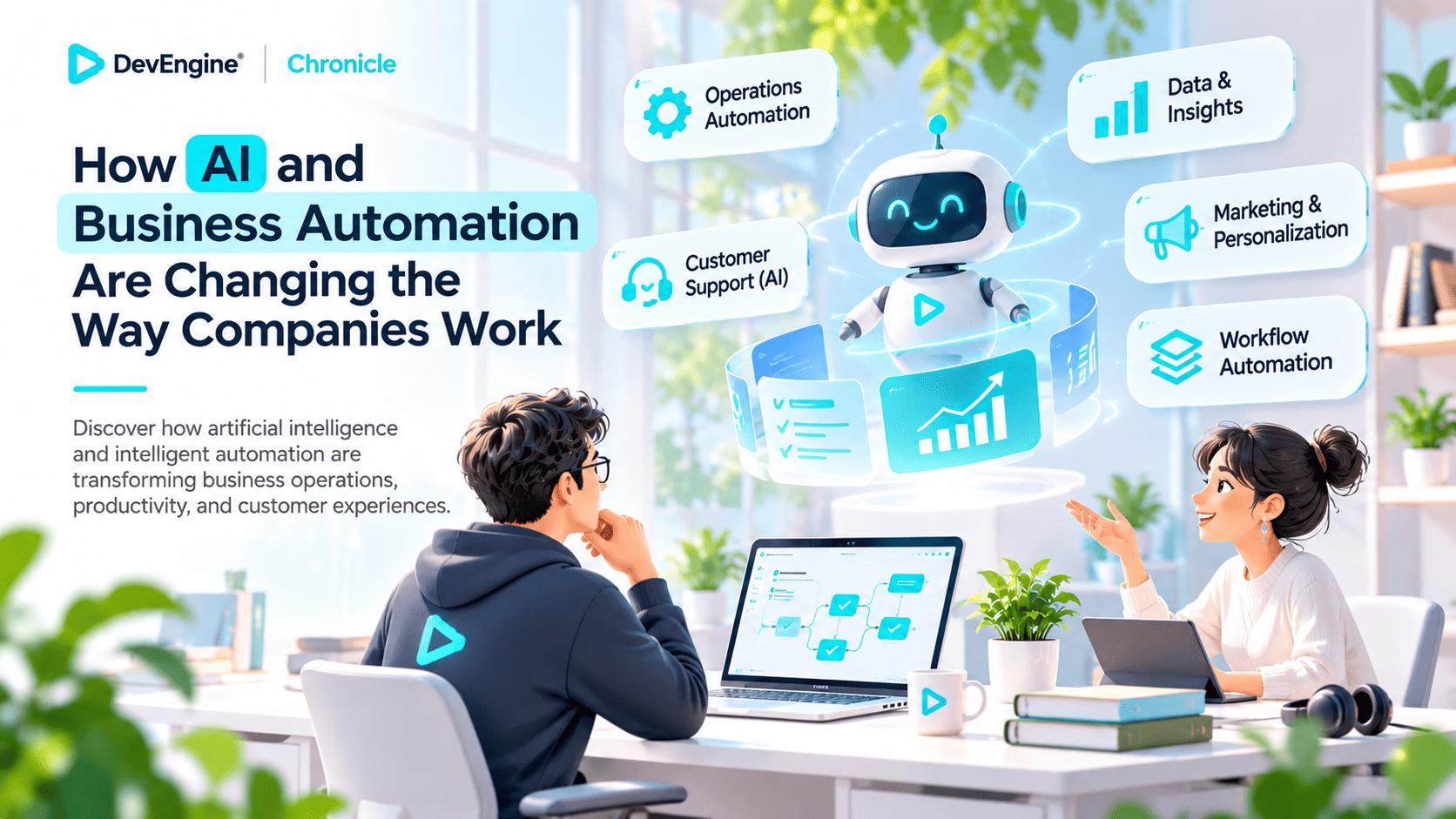
How AI and Business Automation Are Changing the Way Companies Work
Businesses have always looked for better ways to manage their operations, serve customers, and make informed decisions. For many years, improving productivity meant hiring additional employees, expanding infrastructure, or introducing new management processes.
Today, technology is changing that approach.
Artificial intelligence and business automation are creating new opportunities for organizations to complete repetitive tasks, process information, improve customer experiences, and make everyday operations more efficient.
What makes this shift particularly important is that these technologies are no longer limited to large technology companies. Small businesses, startups, service providers, and established organizations can increasingly access tools that were once difficult or expensive to implement.
However, successful adoption requires more than simply adding an AI tool to an existing workflow. Businesses need to understand where automation creates value, where human judgment remains essential, and how different technologies can work together.
1. Understanding AI and Business Automation
Artificial intelligence and automation are closely related, but they are not the same thing.
Business automation involves using technology to perform predefined tasks or workflows with minimal manual intervention.
For example, a business might automatically generate an invoice after an approved purchase or send a reminder before a scheduled appointment.
Artificial intelligence involves systems that can perform tasks associated with human intelligence, such as understanding language, recognizing patterns, generating content, and analyzing information.
For example, an AI-powered support assistant can interpret a customer's question and generate a relevant response.
When combined, AI and automation can create more intelligent business workflows.
A traditional automation system might follow a fixed sequence of instructions, while an AI-enabled workflow may interpret incoming information and determine which predefined process should happen next.
The important distinction is that automation handles processes, while AI can help interpret information and support decisions within those processes.
2. Automating Repetitive Business Operations
One of the most practical applications of automation is reducing repetitive administrative work.
Many businesses spend considerable time handling routine activities that follow predictable patterns.
Examples include:
- Sending appointment confirmations.
- Generating invoices and receipts.
- Updating customer records.
- Assigning tasks to employees.
- Sending payment reminders.
- Organizing incoming inquiries.
- Preparing routine operational reports.
These activities are important, but handling every step manually can consume valuable time.
Automation allows businesses to define workflows that perform these tasks consistently.
For example, consider a service-based company that receives customer bookings.
Without automation, employees may need to confirm each booking, notify the assigned staff member, update a calendar, and send a reminder before the appointment.
An automated workflow can connect these steps.
When a booking is successfully created, the system can send a confirmation, update the schedule, notify the appropriate employee, and prepare a reminder.
This reduces unnecessary manual coordination and helps employees focus on more important responsibilities.
3. AI Is Changing Customer Support
Customer support is another area experiencing significant change.
Customers often expect quick responses, clear information, and convenient ways to resolve problems.
Traditional support teams may struggle when they receive a large volume of similar questions.
AI-powered support systems can help by handling common inquiries, identifying relevant information, and assisting customers with routine requests.
For example, an AI assistant may help customers:
- Understand available services.
- Find answers to common questions.
- Check order or booking information through authorized integrations.
- Navigate product features.
- Receive guidance about basic processes.
These systems can also assist human support teams by summarizing conversations, organizing inquiries, and suggesting relevant information.
However, AI support should not operate without boundaries.
Sensitive issues, financial disputes, complex complaints, and situations requiring human judgment should have clear escalation paths.
The best customer support systems combine automated assistance with accessible human support.
4. Smarter Data Processing and Business Insights
Modern businesses generate information from many sources, including customer interactions, sales systems, marketing platforms, and internal operations.
Understanding this information can help organizations identify opportunities and make better decisions.
AI can support data analysis by identifying patterns, summarizing large amounts of information, and helping users explore business performance.
For example, a company may use AI-assisted analytics to:
- Summarize sales performance.
- Identify changes in customer behavior.
- Categorize customer feedback.
- Highlight unusual operational patterns.
- Prepare management summaries.
- Explore potential business trends.
These capabilities can reduce the time required to understand complex information.
However, AI-generated insights should be reviewed carefully.
Business decisions involving money, employment, customer eligibility, or other important matters should not rely blindly on automated recommendations.
Accurate data, proper validation, and human oversight remain essential.
5. Intelligent Workflow Automation
Traditional automation often follows predefined conditions.
For example:
If a payment is confirmed, generate an invoice.
If an appointment is approaching, send a reminder.
If a task is completed, notify the project manager.
AI can extend these workflows by helping systems interpret information before triggering appropriate actions.
Consider a business that receives customer requests through email.
An AI-assisted workflow could:
- Read and classify an incoming message.
- Identify its general purpose.
- Extract relevant information.
- Assign it to an appropriate department.
- Prepare a suggested response.
- Request human approval before sending when necessary.
This approach can make workflows more flexible while preserving control over important actions.
The goal is not to automate every decision. It is to reduce unnecessary manual effort while keeping critical processes reliable and accountable.
6. AI-Powered Personalization and Marketing
Customers increasingly expect businesses to understand their needs and provide relevant experiences.
AI can help organizations analyze customer preferences, categorize feedback, and support more personalized communication.
For example, businesses may use AI to:
- Group customers according to their interests.
- Summarize feedback from different channels.
- Suggest relevant products or services.
- Assist with marketing content.
- Analyze campaign performance.
- Identify opportunities to improve customer engagement.
When combined with reliable customer data, these capabilities can help businesses create more relevant experiences.
However, personalization must respect customer privacy.
Organizations should collect and process information responsibly, follow applicable privacy requirements, and avoid using sensitive customer information without an appropriate legal basis.
7. How Small Businesses Can Benefit From AI
AI and automation are not exclusively enterprise technologies.
Small businesses can begin with focused improvements that address their everyday challenges.
For example:
Retail businesses: Automate inventory notifications, organize product information, and assist with customer inquiries.
Service providers: Automate appointment reminders, customer follow-ups, and booking notifications.
Marketing agencies: Use AI-assisted research, content organization, and reporting workflows.
Educational organizations: Automate administrative notifications and use intelligent tools to support learning operations.
Software companies: Improve documentation workflows, support ticket classification, and development productivity.
A small business does not need to introduce a complicated AI infrastructure immediately.
Starting with one clearly defined workflow can provide a better understanding of the technology's practical value.
8. The Risks and Limitations Businesses Must Understand
Although AI and automation offer significant opportunities, they also introduce challenges.
Businesses should understand these limitations before implementing new systems.
Data Privacy and Security
AI applications may process customer information, internal documents, or business records.
Organizations should understand where data is stored, how it is processed, who can access it, and whether it is shared with external services.
Incorrect AI Responses
AI systems can generate inaccurate information or produce answers that sound convincing but are incorrect.
Important outputs should be reviewed, especially when they affect customers, finances, or business operations.
Over-Automation
Not every process should be automated.
Human communication, complex decisions, sensitive complaints, and situations requiring empathy may need direct involvement.
Integration Challenges
Businesses often use multiple software platforms.
If AI tools cannot communicate properly with existing systems, they may create additional complexity rather than improve productivity.
Ongoing Costs
AI services may introduce subscription fees, usage-based charges, infrastructure expenses, and maintenance requirements.
Businesses should evaluate the total cost of ownership before committing to a solution.
9. How to Introduce AI and Automation Into Your Business
A successful implementation should begin with a clear business objective.
The following approach can help organizations get started.
Step 1: Identify Repetitive Tasks
Review everyday operations and identify activities that consume time without requiring significant human judgment.
Step 2: Understand the Actual Problem
Determine whether the problem requires basic automation, AI-assisted processing, a new software platform, or simply a better workflow.
Not every business problem needs artificial intelligence.
Step 3: Start With a Small Pilot
Choose one workflow and implement a limited solution.
For example, begin by automating appointment reminders or organizing incoming customer inquiries.
Step 4: Choose Appropriate Tools
Evaluate available platforms based on integration support, security, reliability, cost, and ease of use.
Step 5: Establish Human Oversight
Define which actions can happen automatically and which require human approval.
This is particularly important for sensitive customer interactions, financial operations, and important business decisions.
Step 6: Measure Performance
Compare the workflow before and after implementation.
Useful indicators may include:
- Time required to complete a task.
- Number of manual steps.
- Error rates.
- Customer response time.
- Operational costs.
- Employee feedback.
Step 7: Improve and Expand
Once the initial workflow performs reliably, identify other areas where similar improvements may be valuable.
Gradual implementation helps businesses learn, adapt, and manage risks.
10. The Future of Work: Human Expertise and Intelligent Technology
The future of business is unlikely to be defined by automation alone.
Organizations will continue to depend on human creativity, communication, leadership, experience, and judgment.
AI can support these capabilities by helping people process information, reduce repetitive work, and explore new possibilities.
Employees may increasingly work alongside intelligent assistants, automated workflows, and connected business systems.
This creates an opportunity for organizations to rethink how responsibilities are distributed.
Instead of spending most of their time on routine administrative activities, employees may be able to focus more on customer relationships, strategic planning, innovation, and complex problem-solving.
The most effective approach will be one where technology supports people rather than removing human accountability from important decisions.
Final Thoughts
Artificial intelligence and business automation are changing how organizations approach everyday work.
From streamlining administrative tasks to supporting customer service, analyzing information, and connecting business workflows, these technologies offer practical opportunities to improve operations.
However, successful adoption does not depend on using the most advanced AI tools or automating every available process.
It depends on understanding business challenges, selecting appropriate solutions, protecting information, and measuring meaningful results.
For organizations preparing for the future, the best starting point is often a simple question:
Which everyday business process could become more efficient, reliable, or valuable with the right technology?
At DevEngine, we believe intelligent technology should solve real problems and create measurable value. By combining thoughtful software engineering, practical automation, and responsible AI adoption, businesses can build smarter operations and prepare for sustainable growth.
The future of work is not simply about doing more with machines. It is about helping people achieve more with technology.
DevEngine — Engineering Ideas Into Digital Possibilities.