
From Monolith to Microservices: Choosing the Right Architecture
Understanding software architecture choices, scalability, system complexity, and when to move beyond a monolithic application.

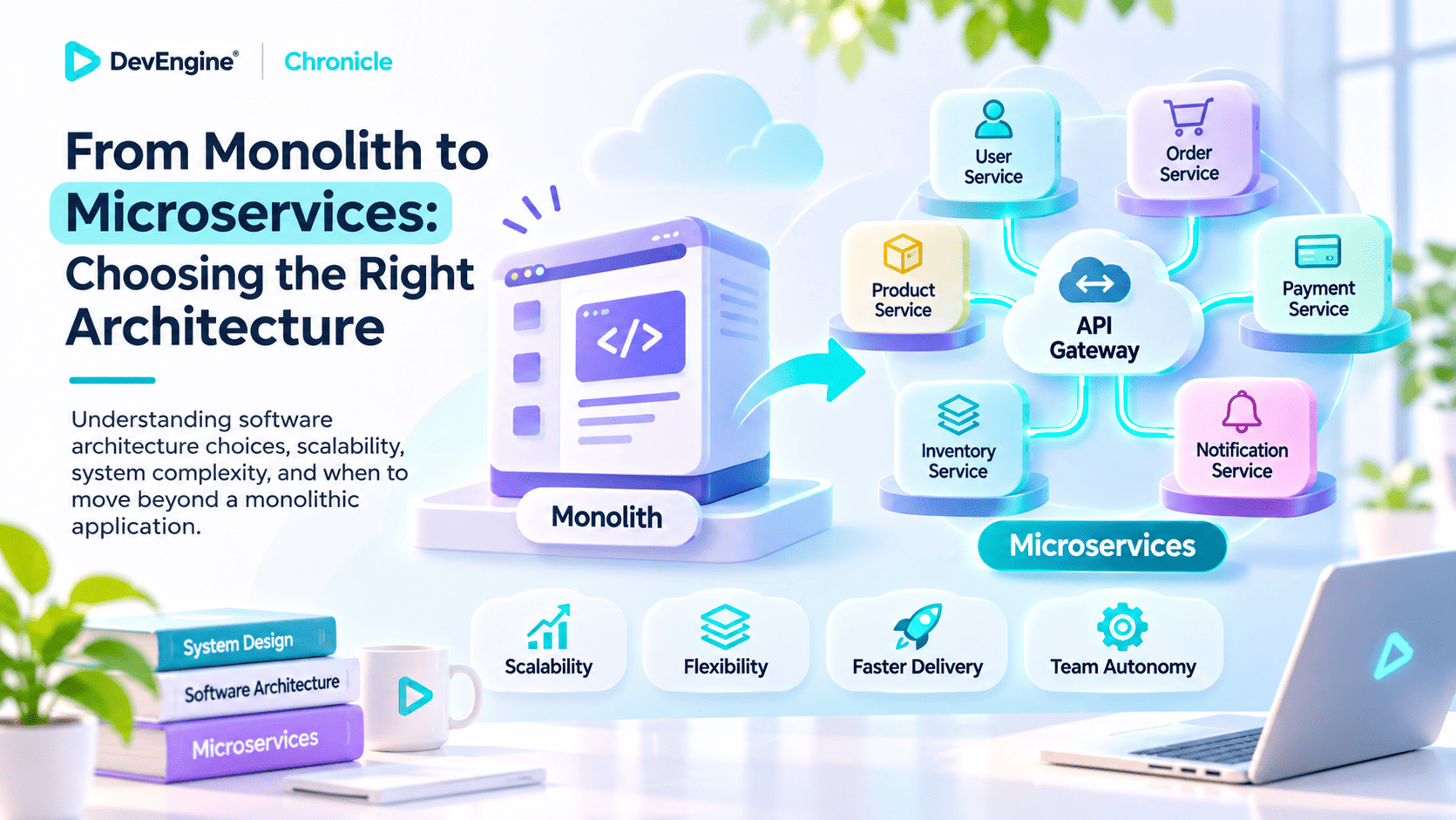
From Monolith to Microservices: Choosing the Right Architecture
Every successful software product eventually faces an important engineering question: how should its architecture evolve as the product grows?
An application that begins with a small set of features may eventually support thousands of users, multiple business operations, complex integrations, and several development teams.
As requirements become more demanding, the architecture that once worked perfectly may begin introducing new challenges.
This is where the discussion around monolithic and microservices architectures becomes important.
Both approaches are widely used in modern software development. Each has its own strengths, limitations, and ideal use cases.
However, choosing between them is not simply a matter of selecting the newest architectural trend. It requires understanding the product, the engineering team, operational requirements, and long-term business goals.
1. Understanding Monolithic Architecture
A monolithic application is built as a unified software system in which its major functional components are developed and deployed together.
For example, an e-commerce platform might contain:
- User authentication.
- Product management.
- Shopping cart functionality.
- Order processing.
- Payment integration.
- Inventory management.
- Administrative features.
In a traditional monolithic architecture, these components generally exist within one application and share the same deployment lifecycle.
They may be organized into separate modules internally, but the application is delivered as a unified unit.
This architecture is often a practical choice for new products because it provides a relatively straightforward development and deployment model.
Developers can work within one codebase, share application logic, and avoid introducing unnecessary infrastructure complexity.
Advantages of Monolithic Architecture
Simpler initial development: Teams can begin building features without first designing communication between multiple independent services.
Easier deployment: The application can be packaged and deployed as one unit.
Simpler debugging: Developers can often trace application behavior within one codebase and execution environment.
Lower operational complexity: A small product may not require service discovery, distributed tracing, message brokers, or multiple deployment pipelines.
Straightforward transactions: Related operations can often use database transactions within a single application boundary.
Challenges of Monolithic Architecture
As the application grows, certain limitations may become more noticeable.
Increasing codebase complexity: A large application can become difficult to understand and maintain if its modules are poorly structured.
Coupled deployments: Even a small change may require rebuilding and deploying the entire application.
Scaling limitations: Different components may have different resource requirements, but scaling the application can mean scaling the whole deployment.
Team coordination: Multiple development teams working in the same codebase may experience conflicts and dependencies.
Technology constraints: Adopting different technologies for specific components can become more difficult.
These challenges do not mean monolithic architecture is inherently bad. They indicate that architectural discipline becomes increasingly important as a product evolves.
2. What Is Microservices Architecture?
Microservices architecture organizes an application into smaller, independently deployable services.
Each service is responsible for a specific business capability and communicates with other services through defined interfaces.
For example, an e-commerce system might contain separate services for:
- User accounts.
- Product catalogs.
- Shopping carts.
- Orders.
- Payments.
- Inventory.
- Notifications.
Each service can be developed, deployed, and scaled independently, depending on the architecture and infrastructure.
A product may expose these services through an API gateway or another communication layer.
This approach allows teams to organize development around business capabilities rather than maintaining every feature inside one application.
Advantages of Microservices Architecture
Independent deployment: Teams can update individual services without necessarily redeploying the entire platform.
Flexible scaling: Services with higher workloads can receive additional resources independently.
Team autonomy: Different teams can own separate services and manage their development lifecycle.
Technology flexibility: Services may use different programming languages, frameworks, or storage technologies when there is a genuine technical reason.
Fault isolation: A failure in one service does not necessarily bring down the entire application, provided dependencies and failure handling are designed appropriately.
Challenges of Microservices Architecture
Microservices introduce their own engineering and operational responsibilities.
Distributed system complexity: Communication between services introduces network failures, latency, retries, and coordination challenges.
Data consistency: Managing related information across separate databases can require additional architectural decisions.
Operational overhead: Monitoring, logging, deployment, infrastructure, and service discovery become more involved.
Testing complexity: Teams must consider individual service behavior as well as integration between services.
Security requirements: Every service boundary introduces additional communication and access-control considerations.
Higher infrastructure costs: Multiple services may require more resources and operational tooling than a simple application.
Microservices can provide flexibility, but they also require mature engineering practices.
3. Monolith vs. Microservices: Understanding the Differences
The two approaches differ mainly in how application responsibilities are organized, deployed, and operated.
Application Structure
A monolithic system generally delivers its main application functionality through one deployment unit.
A microservices system separates business capabilities into independently deployable services.
Deployment
In a monolithic application, changes are commonly released through the main application deployment process.
With microservices, individual services can have separate deployment pipelines and release schedules.
Scaling
A monolith is commonly scaled as a complete application, although its internal components can still be optimized independently.
Microservices allow specific services to scale separately based on their workloads.
Data Management
Monolithic applications often use a shared database with clearly organized internal data ownership.
Microservices may use service-specific data stores, although the exact strategy depends on business and consistency requirements.
Team Organization
A monolithic application can work effectively with small or moderately sized teams.
Microservices can support multiple teams owning independent business capabilities, but only when responsibilities and service boundaries are clearly defined.
Neither architecture automatically guarantees better performance, reliability, or development speed.
Those outcomes depend on implementation quality and operational discipline.
4. When Should You Choose a Monolithic Architecture?
For many products, starting with a monolith is a sensible engineering decision.
A monolithic architecture may be suitable when:
- The product is new and its requirements are still evolving.
- The development team is relatively small.
- Business operations are not yet highly complex.
- The application does not require independent scaling of different capabilities.
- The team wants to minimize infrastructure and deployment overhead.
- The product needs to reach the market quickly.
A modular monolith can be particularly effective.
Instead of placing every feature into one tightly coupled structure, developers organize the application into well-defined internal modules.
For example, an e-commerce application could maintain separate modules for authentication, products, orders, and payments while deploying them together.
This provides architectural organization without introducing the operational complexity of distributed services.
For an early-stage product, that balance can be extremely valuable.
5. When Do Microservices Become a Better Option?
Microservices become worth considering when the application and organization develop requirements that a single deployment model makes difficult to manage.
Some indicators include:
Independent scaling requirements: Certain business capabilities receive significantly more traffic or require different resources.
Large development teams: Multiple teams need clearer ownership and independent delivery workflows.
Frequent deployment bottlenecks: Changes to unrelated components repeatedly interfere with the main application release process.
Distinct business capabilities: Different domains have sufficiently independent responsibilities and data ownership.
Different reliability requirements: Certain services require separate availability, performance, or recovery strategies.
Integration complexity: The product needs to expose and manage multiple independent capabilities.
However, reaching a particular user count or codebase size does not automatically mean microservices are necessary.
Architecture should evolve because of identifiable engineering or business needs, not because a product has reached an arbitrary milestone.
6. The Modular Monolith: A Practical Middle Ground
There is an important architectural option between a tightly coupled monolith and a fully distributed microservices system: the modular monolith.
A modular monolith is deployed as one application but organized into distinct modules with clear responsibilities and boundaries.
For example:
- Authentication module.
- Customer module.
- Product module.
- Order module.
- Payment module.
- Notification module.
Each module should own its business logic and expose well-defined internal interfaces.
Other modules should interact through those interfaces rather than directly accessing internal implementation details.
This structure provides several benefits:
- Clear separation of business responsibilities.
- Easier maintenance and code navigation.
- Lower deployment complexity than microservices.
- Better control over dependencies.
- A clearer path toward extracting independent services if necessary.
A well-designed modular monolith can support substantial growth.
It can also help teams identify which components genuinely need independent deployment before introducing distributed architecture.
7. Database Design and Data Ownership Matter
One of the most important differences between monolithic and microservices systems is how data is managed.
In a monolithic application, multiple modules may use the same database while maintaining clear ownership of their respective data.
For example, the order module owns order-related information, while the inventory module manages stock information.
In a microservices architecture, services often own their data independently.
This helps reduce direct dependencies between services, but it introduces additional challenges.
For example, when a customer places an order, the system may need to coordinate:
- Order creation.
- Inventory reservation.
- Payment processing.
- Order confirmation.
- Customer notification.
These operations may happen across multiple services and databases.
A traditional single-database transaction may no longer be sufficient to coordinate the entire workflow.
Distributed systems often use patterns such as the Saga pattern to coordinate multi-step business transactions and handle failures through compensating actions.
The important lesson is that splitting an application into services also changes how its data and business operations must be managed.
8. Communication Between Microservices
Microservices need reliable communication mechanisms to work together.
Two commonly used approaches are synchronous and asynchronous communication.
Synchronous Communication
In synchronous communication, one service sends a request and waits for another service to respond.
HTTP-based REST APIs and gRPC are common examples.
This approach is useful when a service needs an immediate response to continue an operation.
However, excessive synchronous dependencies can create long request chains and increase latency.
Asynchronous Communication
In asynchronous communication, services exchange messages without requiring the sender to wait for immediate processing.
Message brokers and event-driven systems can support this approach.
For example, when an order is created, an order service may publish an event.
Other services can consume that event to update inventory, prepare notifications, or trigger additional business workflows.
Asynchronous communication can reduce direct dependencies between services, but it introduces considerations such as message ordering, duplicate processing, retries, and eventual consistency.
The communication strategy should match the business requirements.
9. Security and Reliability in Distributed Systems
As an application becomes distributed, its security and reliability requirements become more complex.
Each service may expose internal or external interfaces that need appropriate protection.
Development teams should consider:
- Strong authentication between services.
- Authorization based on service responsibilities.
- Secure communication channels.
- Secret and credential management.
- Input validation.
- Rate limiting.
- Centralized monitoring.
- Structured logging.
- Distributed tracing.
- Timeout and retry policies.
- Circuit breakers where appropriate.
Reliability also requires careful handling of partial failures.
For example, if a notification service becomes unavailable, an order should not necessarily fail if notification delivery is not essential to completing the purchase.
Designing these boundaries helps prevent one service failure from unnecessarily affecting unrelated business operations.
10. Common Architecture Mistakes to Avoid
Choosing an architecture is only the beginning. How it is implemented matters just as much.
Some common mistakes include:
Adopting microservices too early: Introducing distributed infrastructure before the product needs it can slow development and increase costs.
Creating poorly defined service boundaries: Services should represent meaningful business capabilities rather than arbitrary pieces of code.
Sharing databases without clear ownership: Excessive cross-service database access creates hidden dependencies.
Ignoring observability: Distributed applications need reliable logs, metrics, and tracing to diagnose problems.
Overcomplicating communication: Too many synchronous service dependencies can make the entire system fragile.
Treating architecture as permanent: Business requirements and technical constraints change. Architecture should be reviewed and improved as the product evolves.
A good engineering team understands that simplicity is valuable and complexity should be introduced only when it provides a clear benefit.
11. How to Choose the Right Architecture for Your Product
Before selecting an architecture, teams should evaluate several practical questions.
Step 1: Understand Product Complexity
Identify the product's business capabilities, data requirements, integrations, and expected growth.
Step 2: Evaluate Team Size and Experience
Consider whether the team has the skills and operational capacity to manage distributed systems.
Step 3: Understand Scaling Requirements
Determine whether the entire application needs to scale together or whether individual capabilities have substantially different workloads.
Step 4: Evaluate Deployment Requirements
Consider whether independent release cycles are necessary or whether a unified deployment process remains practical.
Step 5: Estimate Operational Costs
Include infrastructure, monitoring, deployment automation, maintenance, and engineering effort.
Step 6: Design Clear Boundaries
Whether choosing a monolith or microservices, organize business responsibilities into understandable modules and services.
Step 7: Review the Decision Over Time
Architecture should evolve as requirements change. Regularly evaluate whether the current design continues to support the product effectively.
12. The Future of Software Architecture
Software architecture continues to evolve as cloud platforms, distributed infrastructure, automation, and development practices improve.
Organizations increasingly combine different architectural approaches according to their requirements.
Some products use modular monoliths for their main business applications while extracting selected capabilities into independent services.
Others use event-driven systems, serverless functions, or managed cloud services to support specific workloads.
There is no universal architecture that works best for every product.
The most effective systems are designed around clear business boundaries, maintainable code, reliable communication, and practical operational requirements.
As products grow, engineering teams should focus on building an architecture that supports change rather than introducing complexity simply to follow industry trends.
Final Thoughts
The decision between monolithic and microservices architecture is not a competition between old and new technologies.
A monolith can be an excellent foundation for a growing product, while microservices can provide valuable flexibility when independent scaling, deployment, and team ownership become important.
The key is understanding the trade-offs.
Starting with a well-structured modular monolith and introducing independent services when genuine requirements emerge can be a practical and sustainable strategy.
At DevEngine, we believe strong software architecture is built through thoughtful engineering decisions. The goal is not to create the most complicated system, but to create a reliable foundation that can evolve with the product.
The best architecture is not the one with the most services. It is the one that solves today's problems while making tomorrow's changes easier.
DevEngine — Engineering Ideas Into Digital Possibilities.