
From Idea to Production: How We Turn Software Concepts Into Real Products
A practical look at the journey from a rough idea to a designed, engineered, tested, and deployed software product.

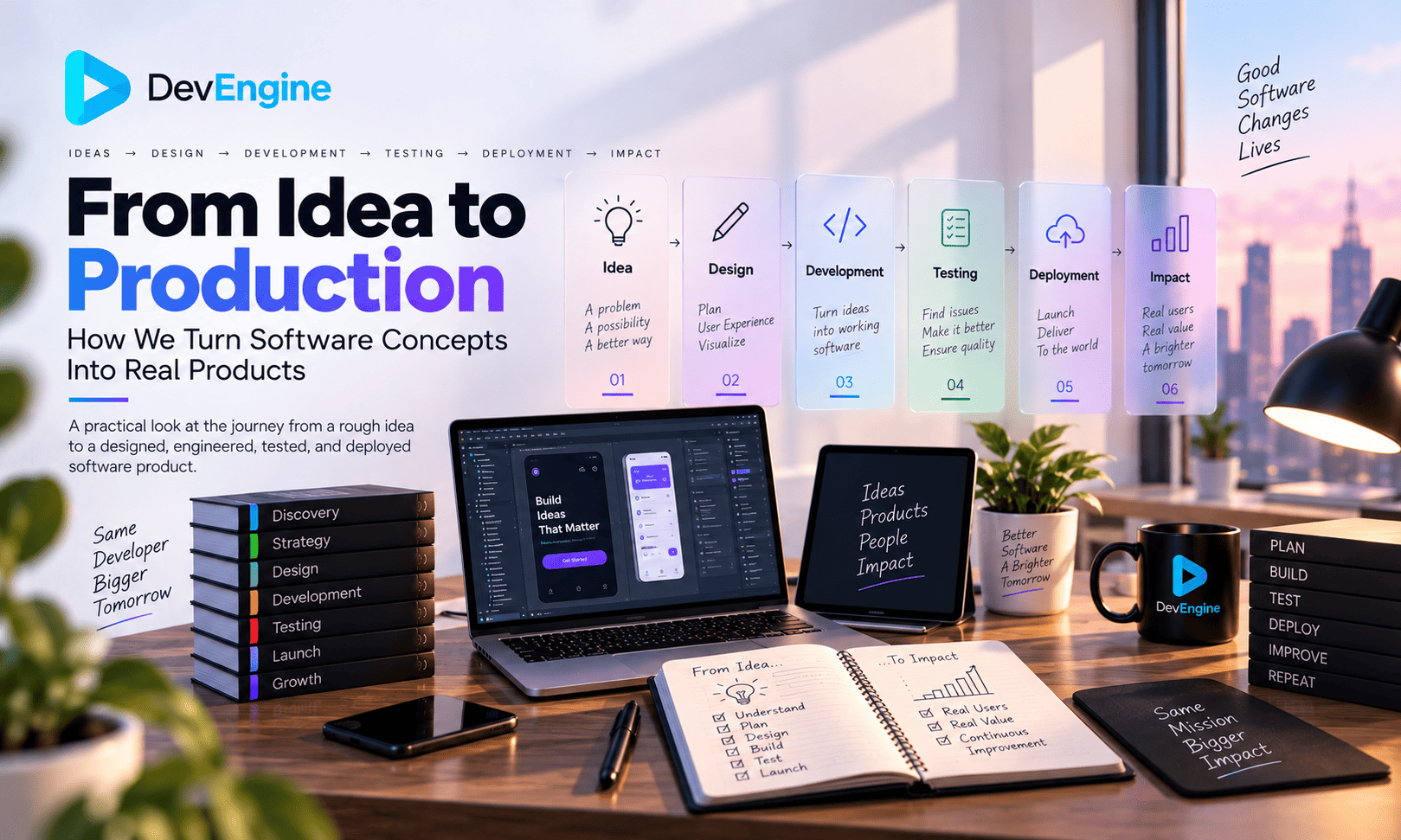
From Idea to Production: How We Turn Software Concepts Into Real Products
Every software product starts with something small.
Sometimes it is a sentence.
Sometimes it is a business problem.
Sometimes it is a sketch on paper.
Sometimes it is simply:
"What if we built this?"
That first idea can feel exciting.
But an idea is not yet a product.
Between the first thought and a real application exists a long chain of decisions.
What problem are we solving?
Who has the problem?
What should the product actually do?
What should it not do?
How should it look?
How should it behave?
How should the data work?
How should it handle failure?
How will it be tested?
How will it reach users?
And perhaps most importantly:
How do we know we are building the right thing?
At DevEngine, we think of product development as a journey rather than a single development phase.
The code is an important part of that journey.
But it is only one part.
Step One: Start With the Problem
The first thing we try to understand isn't the technology.
It is the problem.
A client, founder, business owner, or internal team may arrive with a feature request.
"Build an app."
"Create a dashboard."
"Add an automated system."
"Make a mobile application."
Those requests describe what someone wants built.
They don't always explain why.
So we go deeper.
Who will use it?
What are they struggling with?
What are they doing today?
What makes the current process inefficient?
What happens if nothing changes?
What would a successful solution look like?
The better we understand the problem, the fewer assumptions we need to make later.
Step Two: Define the Product
Once the problem is clear, the idea needs boundaries.
This is where a concept begins turning into a product.
We identify the major users.
We define the primary workflows.
We separate essential functionality from optional functionality.
We identify the information the system needs.
We think about permissions.
We think about integrations.
We think about what the first release actually needs.
This stage is important because software projects can become unnecessarily complicated very quickly.
If everything becomes a requirement, nothing is truly prioritized.
A strong product definition gives the team something much more valuable than a huge feature list:
clarity.
Step Three: Map the Experience
Before building individual screens, we need to understand how users move through the product.
Imagine a user opening the application for the first time.
What do they see?
What should they understand immediately?
What action should they take?
What happens next?
What happens if they make a mistake?
What happens if they have no data?
What happens if they don't have permission?
What happens when the process succeeds?
These questions create the foundation of the user experience.
A product isn't a collection of beautiful screens.
It is a sequence of decisions and interactions.
The experience connects those screens together.
Step Four: Design Before We Build
Once the workflows are understood, we can begin shaping the interface.
This is where ideas become visible.
We explore:
- Layout
- Typography
- Colors
- Navigation
- Components
- Information hierarchy
- Interaction patterns
- Empty states
- Loading states
- Error states
- Responsive behavior
Design isn't only about making software look good.
Good design reduces confusion.
It helps users understand what is happening.
It makes important actions easier to discover.
It gives structure to complex information.
And it gives developers a clearer target to engineer.
The Design Is a Conversation
One thing we've learned is that design shouldn't be treated as a frozen document.
Sometimes a design decision reveals a technical problem.
Sometimes a technical limitation reveals a better design.
Sometimes user research changes the workflow.
Sometimes a workflow change affects the architecture.
The best results happen when design and engineering communicate continuously.
Instead of:
Design → handoff → development
we prefer:
Design ↔ Engineering
The two disciplines should keep influencing each other.
Step Five: Choose the Architecture
Once we understand the product and its workflows, we can make better technical decisions.
This is where architecture becomes important.
We consider things like:
- Application structure
- Backend requirements
- Database design
- Authentication
- Authorization
- API architecture
- State management
- File storage
- Notifications
- Analytics
- Security
- Deployment
- Monitoring
The goal isn't to create the most complicated architecture possible.
The goal is to create an architecture that fits the product.
A small product should be allowed to be simple.
A growing product should have room to evolve.
The architecture should support the current problem while avoiding unnecessary complexity.
Choosing Technology for the Product
Technology choices should follow the requirements.
Sometimes Flutter makes sense for a cross-platform mobile product.
Sometimes a web application needs a modern JavaScript framework.
Sometimes a managed backend can dramatically reduce infrastructure overhead.
Sometimes a custom backend is necessary.
Sometimes an existing service solves a problem better than building everything internally.
There isn't one technology stack that is correct for every project.
The question we ask is:
What combination of technologies gives this product a reliable path from development to production?
Technology is a tool.
The product is the goal.
Step Six: Build the Foundation First
Once architecture is defined, development begins.
But even here, we don't want to immediately build every feature.
First comes the foundation.
Project structure.
Environment configuration.
Authentication.
Core data models.
Navigation.
Design system.
Reusable components.
API or backend structure.
Error handling.
Logging.
Basic testing infrastructure.
The foundation may not be the most exciting part of the product.
Users may never directly see it.
But it determines how easily the rest of the product can be built.
Step Seven: Build the Core Workflow
After the foundation is stable, we focus on the most important user journey.
Not every feature.
The core workflow.
If the product is a hotel management system, perhaps that means managing reservations.
If it is an educational application, perhaps it means learning and completing an assessment.
If it is a business dashboard, perhaps it means managing the information that drives the business.
The exact workflow changes from product to product.
The principle doesn't.
Build the thing that proves the product's central value.
Build in Layers
A useful development process is often incremental.
First:
Make it work.
Then:
Make it reliable.
Then:
Make it clear.
Then:
Make it fast.
Then:
Make it beautiful.
Trying to perfect everything simultaneously can slow development dramatically.
Incremental development lets us validate assumptions earlier.
We can discover problems before they spread across the entire system.
Step Eight: Handle the Unhappy Paths
A product isn't ready because the happy path works.
We also need to consider what happens when things go wrong.
What if the network disappears?
What if the API returns an error?
What if the user enters invalid information?
What if a database query returns nothing?
What if authentication expires?
What if the user doesn't have permission?
What if a request takes too long?
What if the application is restarted halfway through an operation?
These situations are not exceptions.
They are part of real software.
Good engineering plans for them.
Step Nine: Test Against Reality
Testing is where assumptions meet reality.
We test the primary workflows.
Then we test edge cases.
Then we test different devices.
Different screen sizes.
Different network conditions.
Different user roles.
Different data states.
Different failure conditions.
Testing isn't simply about finding bugs.
It is about discovering where our understanding of the product was incomplete.
Every unexpected behavior is information.
And information gives us an opportunity to improve the product before users depend on it.
Step Ten: Prepare for Production
Development environments are forgiving.
Production isn't.
Before release, we need to think about:
- Environment variables
- Security rules
- API configuration
- Database permissions
- App signing
- Store requirements
- Build configuration
- Error monitoring
- Crash reporting
- Performance
- Backups
- Deployment processes
A product can work perfectly on a developer's machine and still fail during deployment.
That's why production preparation needs to be treated as part of development rather than something that happens at the very end.
Step Eleven: Ship
Eventually, there is a moment when we have to stop building and release the product.
This can be difficult.
There is always another feature.
Another animation.
Another optimization.
Another thing that could be improved.
But at some point, the product needs to meet reality.
Users provide something development environments cannot:
real feedback.
That feedback is one of the most valuable resources a product can receive.
Launch Is the Beginning of the Feedback Loop
After release, we start learning again.
Users show us which features matter.
They reveal confusing workflows.
They find edge cases.
They request improvements.
They expose assumptions we didn't realize we were making.
Analytics can show where users stop.
Support conversations can explain why.
Crash reports can reveal technical problems.
Reviews can reveal expectations.
The product becomes a living source of information.
Step Twelve: Improve Through Iteration
A product should evolve.
The first release is a foundation.
The next release should be informed by what we learned from the first.
Some features will become more important.
Some will become less important.
Some assumptions will be proven correct.
Others will need to change.
This is why we prefer iteration over trying to predict everything in advance.
Build.
Release.
Learn.
Improve.
Repeat.
What Happens When the Plan Changes?
It will.
Almost every serious software project encounters changes.
Requirements change.
Users change.
Business priorities change.
Technology changes.
Constraints change.
Sometimes the original solution turns out to be wrong.
A good process shouldn't collapse when the plan changes.
It should have enough structure to absorb change.
That's another reason we value clear architecture and modular systems.
Change is easier when the product isn't tightly coupled around every assumption.
The Difference Between a Demo and a Product
A demo can prove that an idea works.
A product has to survive reality.
A demo might have:
One user.
One workflow.
Hardcoded data.
Perfect inputs.
No error handling.
No authentication.
No monitoring.
A real product needs much more.
It needs reliable workflows.
It needs security.
It needs proper data handling.
It needs maintainability.
It needs deployment.
It needs monitoring.
It needs a plan for what happens when something goes wrong.
That transition—from demonstration to dependable product—is where engineering becomes especially important.
Building for the Next Version
We also think about what happens after the first release.
Not by building everything in advance.
But by making decisions that don't unnecessarily block future growth.
A good foundation should make the next version easier to build.
A reusable component can support multiple screens.
A clean API can support additional clients.
A sensible database structure can support new workflows.
A modular architecture can allow features to evolve independently.
The goal isn't to predict the future perfectly.
It is to avoid making the future unnecessarily difficult.
What We Are Really Building
When we build software, we're not really building screens.
We're building systems that people depend on.
A customer depends on a booking system.
A business depends on its dashboard.
A student depends on an educational platform.
A team depends on internal tools.
A founder depends on the product that represents their idea.
That responsibility changes how we think about development.
The goal isn't simply to make something that works.
The goal is to make something that can keep working.
Our Process Is Still Evolving
There isn't a single perfect process.
The way we build will continue to change as DevEngine grows.
We'll discover better tools.
Better workflows.
Better testing strategies.
Better ways to communicate.
Better ways to design.
Better ways to deploy.
That's okay.
A development process should evolve just like the products it creates.
What matters is maintaining the principles underneath it:
Understand the problem.
Design with purpose.
Build deliberately.
Test realistically.
Ship responsibly.
Learn continuously.
Improve relentlessly.
From an Idea to Something Real
The journey from idea to production is longer than it looks.
An idea becomes a problem definition.
A problem becomes a product concept.
A concept becomes workflows.
Workflows become designs.
Designs become architecture.
Architecture becomes code.
Code becomes a tested system.
The system becomes a release.
The release becomes feedback.
And feedback becomes the next version.
That is the cycle.
There is no magic step where everything suddenly becomes a product.
It happens through hundreds of connected decisions.
The Engine Behind the Product
This is what DevEngine is trying to build.
Not simply a team that writes code.
A process that can take an idea seriously enough to turn it into something real.
Sometimes that means simplifying.
Sometimes it means rebuilding.
Sometimes it means saying no to unnecessary complexity.
Sometimes it means spending more time understanding before writing code.
And sometimes it means shipping something imperfect so we can finally learn from reality.
The destination is a working product.
But the real craft is everything that happens along the way.
The Journey Continues
Every product starts with an idea.
Every idea contains uncertainty.
The job of engineering isn't to eliminate that uncertainty completely.
It's to reduce it step by step.
Understand.
Design.
Build.
Test.
Ship.
Learn.
Improve.
Then do it again.
That's how concepts become products.
And that's how we're building at DevEngine.
Have a product concept you are planning to build? Contact our studio to discuss the technical requirements and architecture.