
Database Indexing Explained: How to Make Applications Faster
Understanding database indexes, query execution, and optimization techniques for building faster and more scalable applications.

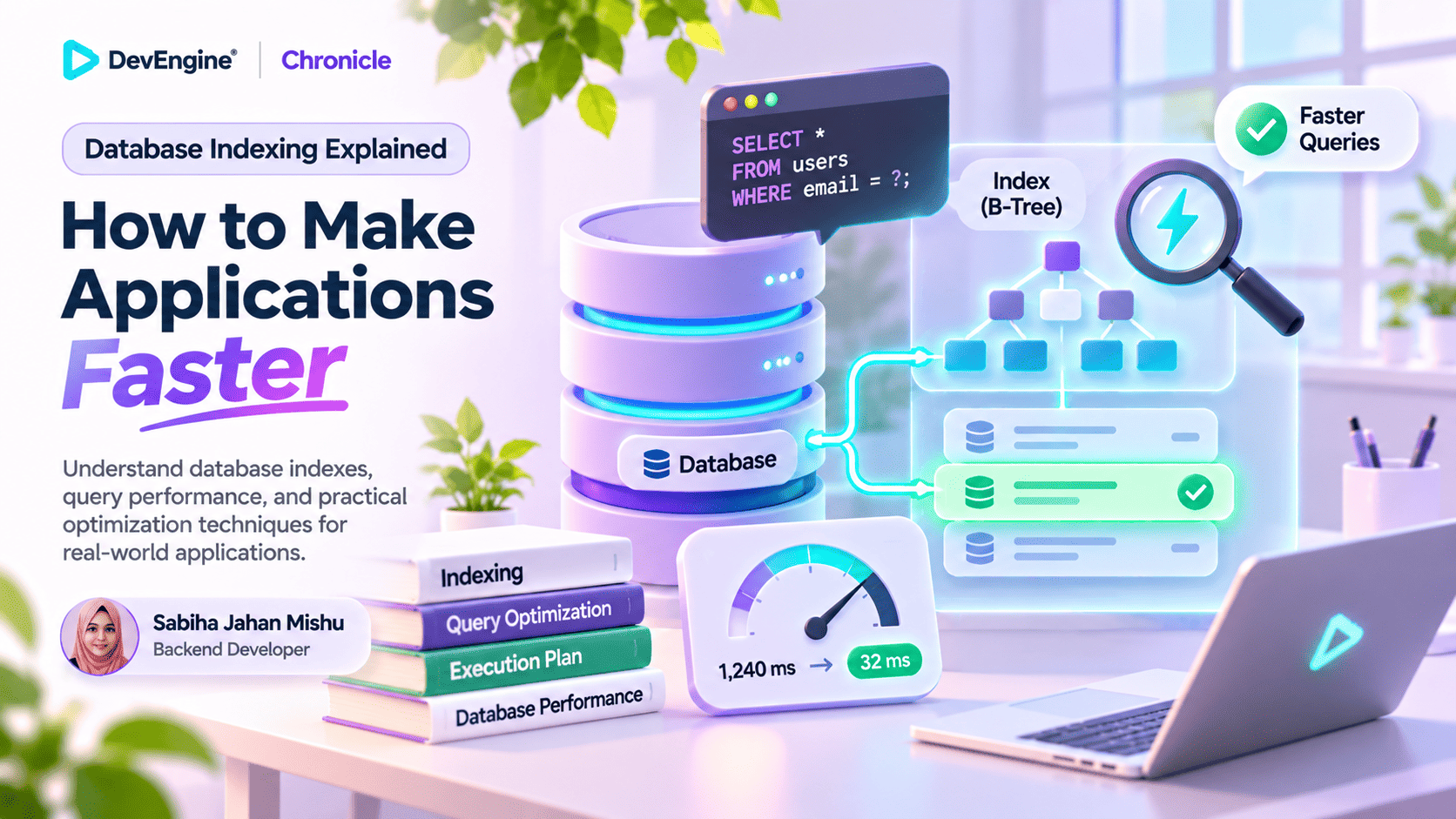
Database Indexing Explained: How to Make Applications Faster
As applications grow, their databases become responsible for managing increasingly large amounts of information.
A small application might initially contain only a few hundred records. Over time, it may grow to millions of users, transactions, products, orders, and other records.
At that point, retrieving information efficiently becomes an important engineering challenge.
Imagine opening an e-commerce application and waiting several seconds every time you search for a product. Or imagine a business dashboard taking too long to display customer records because the database needs to examine an enormous amount of information.
These problems can affect user experience, application performance, and overall system reliability.
One of the most effective techniques developers use to improve database query performance is database indexing.
Understanding how indexes work is an essential skill for backend developers who want to build efficient, scalable, and maintainable applications.
1. What Is Database Indexing?
A database index is a data structure that helps a database locate records more efficiently without examining every row in a table.
Think about a physical book.
If you want to find a particular topic, you do not need to read every page. You can look at the index at the end of the book, find the relevant topic, and navigate directly to the required pages.
Database indexes work using a similar concept.
Consider a users table containing thousands of records. If an application frequently searches for users using their email addresses, the database may need to examine many rows to find the matching record when no suitable index exists.
An index on the email column provides an additional structure that helps the database locate matching records more efficiently.
For example:
SELECT *
FROM users
WHERE email = 'user@example.com';
If an appropriate index exists on the email column, the database can potentially use it to locate the matching record without performing a full table scan.
The exact execution strategy depends on the database engine, available indexes, table statistics, and query conditions.
The main purpose of indexing is simple: reduce the amount of work required to retrieve information.
2. How Does a Database Work Without an Index?
To understand why indexing matters, it helps to examine how a database searches for information.
Suppose an application contains a products table with 500,000 records.
A user searches for a product with a particular SKU:
SELECT *
FROM products
WHERE sku = 'PRD-10582';
If there is no useful index on the SKU column, the database may perform a sequential scan.
This means it examines rows to determine which ones match the requested condition.
For a large table, this can require significant work.
The problem becomes more noticeable when:
- Tables contain millions of records.
- Queries execute frequently.
- Multiple users access the application simultaneously.
- Complex filtering conditions are involved.
- Several database operations depend on the same data.
However, a full table scan is not always inefficient. For small tables or queries that retrieve a large percentage of records, scanning the table may actually be the better execution strategy.
Database engines make decisions based on their query optimizer and available statistics.
3. How Indexes Improve Query Performance
When an index is created, the database maintains an additional data structure containing indexed values and information that helps locate their corresponding records.
Many relational database systems use B-tree or B-tree-like structures for common index types.
These structures organize values in a way that supports efficient searching.
For example:
CREATE INDEX idx_users_email
ON users(email);
This creates an index on the email column.
Now, when an application executes a query that filters by email, the database may use the index to locate the matching record more efficiently.
Indexes can improve performance for operations involving:
- Searching with WHERE conditions.
- Joining related tables.
- Sorting with ORDER BY.
- Grouping with GROUP BY.
- Enforcing uniqueness.
- Finding records within ranges.
The performance improvement depends on the query, index structure, data distribution, and database implementation.
An index is not a guarantee that every query will become faster.
The goal is to create indexes that support the queries an application actually performs.
4. Common Types of Database Indexes
Different database systems support different index types, each designed for particular workloads.
Understanding the common types helps developers choose an appropriate indexing strategy.
B-Tree Index
B-tree indexes are widely used in relational databases.
They organize indexed values in a balanced tree structure that supports efficient equality and range searches.
They are useful for queries such as:
SELECT *
FROM products
WHERE price > 1000;
They can also support sorting and equality conditions.
Hash Index
Hash indexes use a hashing mechanism to organize values.
They are primarily useful for equality-based lookups in database systems that support them.
For example:
SELECT *
FROM users
WHERE user_id = 105;
Hash indexes are generally not suitable for range searches because they do not maintain values in an ordered structure.
Unique Index
A unique index ensures that indexed values satisfy a uniqueness constraint.
For example, an application may require every user to have a unique email address.
CREATE UNIQUE INDEX idx_users_unique_email
ON users(email);
This helps prevent duplicate email values from being stored, subject to the database's NULL handling rules.
Composite Index
A composite index contains multiple columns.
For example:
CREATE INDEX idx_orders_user_status
ON orders(user_id, status);
This can support queries that filter using both user_id and status.
Composite indexes require careful planning because column order can influence which queries benefit from them.
Full-Text Index
Full-text indexes are designed to support text-search operations.
They can help applications search words and phrases within larger text fields, such as product descriptions, articles, and documents.
The implementation and available search capabilities vary across database systems.
5. Understanding Composite Indexes and Column Order
One of the most important indexing concepts is column order.
Consider an orders table with the following columns:
- order_id
- user_id
- status
- created_at
- total_amount
Suppose an application frequently executes this query:
SELECT *
FROM orders
WHERE user_id = 25
AND status = 'completed';
A composite index could be created:
CREATE INDEX idx_orders_user_status
ON orders(user_id, status);
The order of columns matters.
In many B-tree implementations, an index beginning with userid can also support queries filtering by userid alone.
However, it may not provide the same benefit for a query filtering only by status.
For example:
SELECT *
FROM orders
WHERE user_id = 25;
This may benefit from the composite index.
But:
SELECT *
FROM orders
WHERE status = 'completed';
May require a different index depending on the query workload and database optimizer.
Developers should design composite indexes around actual query patterns rather than simply combining every frequently used column.
6. Indexing Can Also Improve JOIN Operations
Applications frequently retrieve information from multiple related tables.
For example, an e-commerce platform may have users and orders tables.
A query might retrieve all orders belonging to a particular customer:
SELECT
    users.name,
    orders.order_id,
    orders.total_amount
FROM users
JOIN orders
ON users.id = orders.user_id
WHERE users.id = 25;
Indexes on the relevant join and filtering columns can help the database locate matching records more efficiently.
For example:
CREATE INDEX idx_orders_user_id
ON orders(user_id);
The users table may already have an index on its primary key.
Indexing foreign-key columns can be particularly useful for common joins, although the best strategy depends on the database engine and query workload.
7. The Hidden Cost of Database Indexes
Indexes can significantly improve read performance, but they are not free.
Every index introduces additional storage requirements and maintenance work.
When a record is inserted, updated, or deleted, the database may also need to update relevant indexes.
This creates several trade-offs.
Additional Storage
Indexes consume disk space and may increase memory usage.
Applications with many indexes can require considerably more storage than applications with only the underlying tables.
Slower Write Operations
Insert, update, and delete operations may become more expensive because the database must maintain the affected indexes.
Maintenance Overhead
Some indexes may become less useful over time as application behavior and data distribution change.
Developers should review index usage and remove unnecessary indexes carefully.
The objective is not to create as many indexes as possible.
It is to maintain the right indexes for the application's workload.
8. How to Identify Slow Queries
Before creating an index, developers should understand which queries are actually causing performance problems.
Modern database systems provide tools that help inspect query execution.
For example, PostgreSQL provides EXPLAIN and EXPLAIN ANALYZE.
EXPLAIN ANALYZE
SELECT *
FROM users
WHERE email = 'user@example.com';
These commands help developers understand how PostgreSQL plans and executes a query.
Important information may include:
- Sequential scans.
- Index scans.
- Join strategies.
- Estimated and actual row counts.
- Execution time.
- Rows removed by filters.
Developers should pay attention to the difference between estimated and actual row counts because inaccurate estimates can influence query planning.
Other database systems provide their own execution-plan tools.
For MySQL, developers can use EXPLAIN and, where supported, EXPLAIN ANALYZE.
The important principle is to measure query behavior before making optimization decisions.
A query that looks inefficient in source code may already be optimized by the database engine.
9. Practical Database Indexing Mistakes to Avoid
Poor indexing decisions can create unnecessary complexity and reduce database performance.
Here are some common mistakes developers should avoid.
Indexing Every Column
Adding an index to every column is rarely a good strategy.
Some indexes may never be used, while still increasing storage and write overhead.
Ignoring Real Query Patterns
Indexes should support the application's actual queries.
Creating indexes without understanding how data is retrieved can lead to wasted resources.
Forgetting Composite Index Order
The order of columns in a composite index can affect which queries benefit from it.
Developers should examine filtering and sorting patterns before choosing the column sequence.
Overlooking Write Performance
A system with frequent inserts and updates may suffer if it maintains too many unnecessary indexes.
Ignoring Query Plans
Creating an index does not guarantee that the optimizer will use it.
Always inspect execution plans and measure actual performance.
Keeping Unused Indexes
Indexes that no longer support important queries may create unnecessary storage and maintenance costs.
Regular database monitoring can help identify candidates for review.
10. Database Indexing in Real-World Applications
The importance of indexing becomes clearer when examining common application scenarios.
E-Commerce Applications
An online store may frequently search products by SKU, category, brand, and price.
Appropriate indexes can help support product discovery and filtering.
Financial Applications
Expense tracking and financial platforms may retrieve transactions by user, account, category, and date range.
Indexes designed around these access patterns can improve reporting and transaction history queries.
Hotel Management Systems
A hotel management platform may search reservations by property, guest, room, booking status, and check-in date.
Well-designed indexes can help the system retrieve reservation information efficiently.
Content Management Systems
A publishing platform may retrieve articles by slug, category, publication status, and creation date.
Indexes can help support public article pages and administrative content management.
These examples demonstrate that indexing should be based on how a particular application accesses its data.
There is no single indexing strategy that works equally well for every product.
11. A Practical Process for Optimizing Database Queries
Developers can follow a structured process to improve database performance.
Step 1: Identify Performance Problems
Use application monitoring and database metrics to find slow or frequently executed queries.
Step 2: Understand the Query
Review filtering conditions, joins, sorting, selected columns, and expected result sizes.
Step 3: Inspect the Execution Plan
Use the database's query analysis tools to understand how the query is executed.
Step 4: Design an Appropriate Index
Choose an index type and column order that match the query's access pattern.
Step 5: Measure the Results
Compare query performance before and after the change using representative data and workloads.
Step 6: Monitor Write Performance
Check whether the new index introduces additional overhead for inserts, updates, or deletes.
Step 7: Review Index Usage Over Time
Application behavior changes. Periodically review whether existing indexes continue to provide value.
This process helps teams optimize based on evidence rather than assumptions.
12. The Future of Database Performance Engineering
As digital products become more data-intensive, database performance will remain an important part of software engineering.
Modern database systems continue improving query optimizers, indexing capabilities, storage engines, and monitoring tools.
Cloud-managed databases also provide additional visibility into workload patterns and performance bottlenecks.
However, automated infrastructure cannot replace thoughtful data modeling and query design.
Developers still need to understand how applications retrieve information, how database structures affect performance, and how optimization decisions influence the complete system.
The most effective database engineering combines good architecture, efficient queries, appropriate indexing, and continuous measurement.
Final Thoughts
Database indexing is one of the fundamental techniques behind efficient data retrieval.
By understanding how indexes work, choosing appropriate index types, analyzing query execution plans, and avoiding unnecessary indexes, developers can improve application performance while managing storage and write overhead.
But successful database optimization is not about adding indexes everywhere.
It is about understanding the application's data access patterns and making informed engineering decisions.
At DevEngine, we believe great backend engineering is built on more than writing queries. It requires understanding how data moves through an application and designing systems that remain efficient as they grow.
Fast applications begin with thoughtful engineering, and efficient data access is one of the foundations of great software.
DevEngine — Engineering Ideas Into Digital Possibilities.