
Building From Zero: The Story Behind DevEngine
Before there was a company, there were unfinished ideas, difficult projects, long nights, and one decision to keep building.

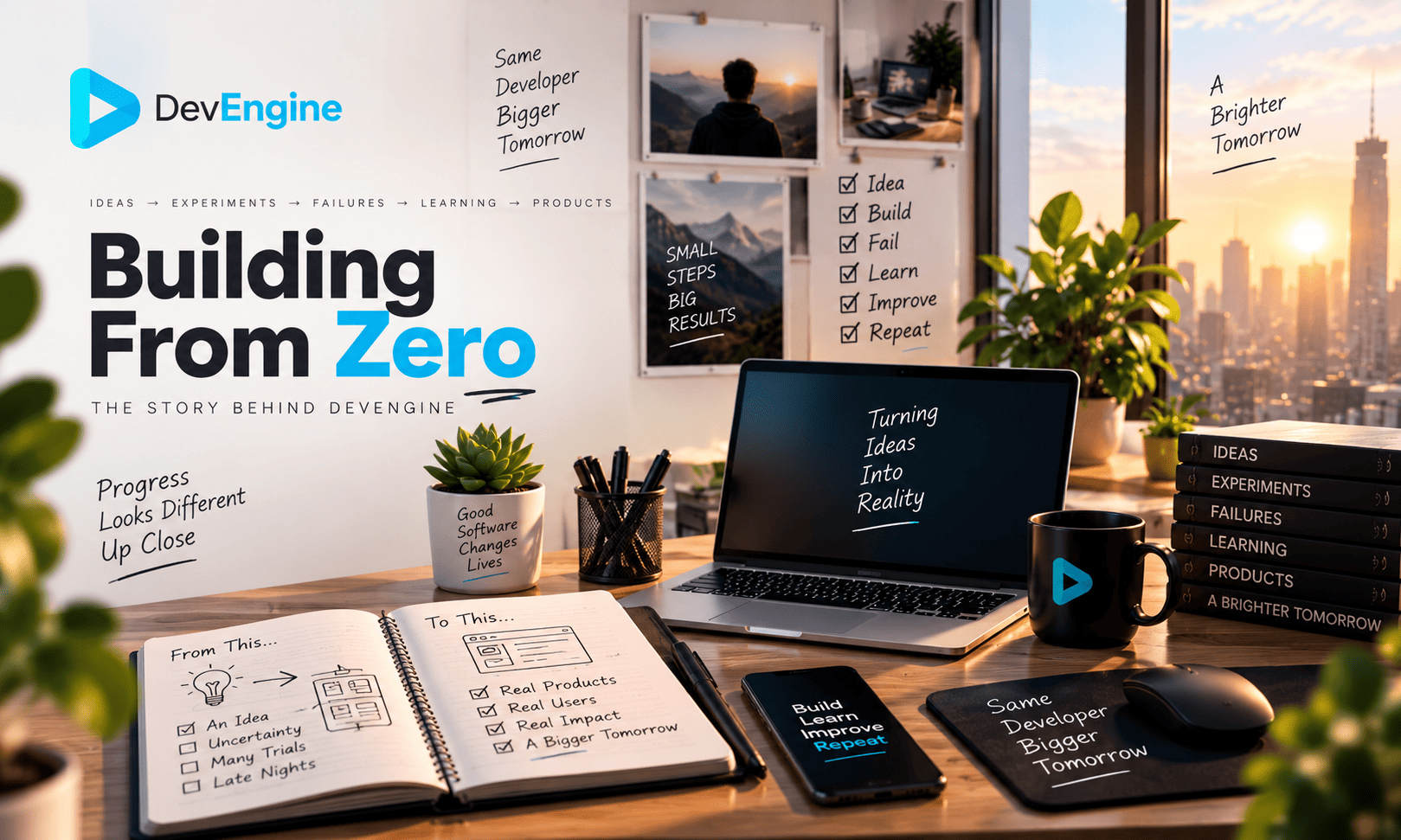
Building From Zero: The Story Behind DevEngine
There was no perfect starting point.
No large team.
No fully documented business plan.
No massive office.
No roadmap that explained exactly where everything would lead.
There was simply an idea:
Build something useful.
Then build something better.
Then keep going.
That is how DevEngine started taking shape.
Not as a company that suddenly appeared one day, but as the result of hundreds of small decisions, experiments, projects, mistakes, lessons, and moments where the easiest option would have been to stop.
Starting With What I Had
Every journey has a starting point.
For DevEngine, that starting point was simple: a developer, a computer, a collection of ideas, and a willingness to learn.
At the beginning, the focus was mostly technical.
Learn the framework.
Understand the backend.
Build the interface.
Connect the database.
Fix the errors.
Deploy the application.
Repeat.
There was always another technology to understand and another problem waiting to be solved.
Sometimes the project was clear.
Sometimes the requirements changed halfway through.
Sometimes the solution worked perfectly in development and behaved completely differently after deployment.
But every project added something.
A little more knowledge.
A little more confidence.
A better understanding of architecture.
A better understanding of users.
A better understanding of what software development actually means.
The First Realization
One of the biggest changes happened when I stopped looking at projects as collections of screens.
A software product is not just a collection of screens.
It is a system.
There is a user behind every interaction.
There is a problem behind every feature.
There is a business reason behind every workflow.
There is infrastructure behind every successful deployment.
And there are hundreds of small decisions connecting all of those pieces together.
That realization changed the way I built.
Instead of asking:
"How do I build this screen?"
The question became:
"What is this supposed to accomplish?"
That shift sounds small.
It wasn't.
It changed everything.
Projects Became Experiments
Not every project was created with the intention of becoming a successful product.
Some were experiments.
Some were learning exercises.
Some started because a particular problem needed a solution.
Some were ideas that sounded great initially but changed completely during development.
And some simply didn't work.
But that didn't make them useless.
An unfinished project can still teach you architecture.
A failed feature can teach you product thinking.
A difficult deployment can teach you infrastructure.
A confusing user flow can teach you design.
A bug can reveal a weakness in the system.
Every project became an experiment.
And every experiment produced information.
The Hard Part Nobody Sees
From the outside, software development can look surprisingly simple.
An application appears on a phone.
A website loads in a browser.
A button is pressed.
Something happens.
But behind that simple interaction can be weeks or months of work.
There are authentication systems.
Databases.
APIs.
State management.
Validation.
Security rules.
Error handling.
Responsive layouts.
Testing.
Deployment pipelines.
Store requirements.
Analytics.
Crash monitoring.
And then there are the problems that nobody planned for.
The internet disappears.
A request times out.
A database rule blocks a feature.
A package changes its API.
A build suddenly fails.
A production-only bug appears.
A design that looked perfect on a large screen breaks on another device.
These are the parts users rarely see.
But these are the parts that teach developers how to build real software.
Learning to Start Again
One of the most important skills I learned wasn't a programming language.
It was knowing when to start again.
Sometimes a solution becomes too complicated.
Sometimes the architecture was designed around assumptions that turned out to be wrong.
Sometimes a feature keeps accumulating patches until the original solution no longer makes sense.
And sometimes the fastest way forward is to step back.
Delete the unnecessary parts.
Understand the problem again.
Then rebuild.
Starting over can feel like losing progress.
But sometimes rebuilding is actually how progress happens.
The second version usually contains lessons that the first version didn't have.
The third version contains lessons from both.
That is how experience accumulates.
From Projects to a Process
Eventually, something became clear.
Building software repeatedly creates patterns.
The tools may change.
The projects may change.
The users may change.
But many of the underlying challenges remain similar.
Understand the problem.
Define the requirements.
Design the experience.
Choose the architecture.
Build the core.
Test the important paths.
Deploy.
Collect feedback.
Improve.
That became the beginning of a repeatable process.
And that process became one of the foundations of DevEngine.
The Meaning Behind the Name
DevEngine is built around a simple idea.
An engine takes something and moves it forward.
That is how I think about software engineering.
An idea starts somewhere.
Engineering gives it structure.
Design gives it an experience.
Development turns it into a working system.
Testing challenges it.
Deployment puts it into the real world.
Feedback pushes the next iteration forward.
The engine keeps moving.
That is what DevEngine represents.
Not one particular framework.
Not one particular programming language.
But the continuous process of turning ideas into reality.
Growing Without Pretending
There is a temptation when building a company to make everything look perfect.
Perfect branding.
Perfect products.
Perfect announcements.
Perfect success stories.
But real development doesn't look like that.
Real development is messy.
There are unfinished branches.
There are failed builds.
There are features that get redesigned.
There are ideas that get abandoned.
There are days when progress feels almost invisible.
And then there are moments when everything suddenly comes together.
A product finally works.
A deployment succeeds.
A user actually uses something you built.
A difficult bug finally disappears.
A project that existed as an idea becomes something real.
Those moments matter.
But they only exist because of everything that happened before them.
The Value of Small Progress
One thing I learned while building is that progress doesn't always look impressive.
Sometimes progress is simply understanding a problem that was confusing yesterday.
Sometimes it is replacing a fragile solution with a better one.
Sometimes it is cleaning up code nobody will ever see.
Sometimes it is improving a loading state.
Sometimes it is making a database rule safer.
Sometimes it is learning why a previous decision was wrong.
These things don't always make good social media posts.
But they make better software.
And better software is built through thousands of these small improvements.
From Developer to Builder
There is also a difference between being a developer and becoming a builder.
A developer can be given a specification and implement it.
A builder needs to understand what should exist in the first place.
That means thinking about:
- Users
- Problems
- Business requirements
- Product experience
- Technical architecture
- Performance
- Security
- Maintenance
- Deployment
- Future growth
The further I went, the more I realized that writing code was only one part of the job.
The bigger challenge was making good decisions about what code should exist.
That became a major part of the DevEngine mindset.
Building Something Bigger Than One Project
Eventually, the idea became bigger than any single application.
There were different products.
Different technologies.
Different industries.
Different problems.
But there was a common thread connecting them.
Take an idea seriously.
Understand the problem.
Build a practical solution.
Don't overcomplicate what doesn't need to be complicated.
Engineer carefully where complexity is necessary.
Ship the product.
Then improve it.
That consistency is what I wanted DevEngine to represent.
There Is Still a Long Way to Go
DevEngine is not a finished story.
It is still being built.
There are new products to explore.
New technologies to learn.
New problems to solve.
New mistakes waiting to teach something.
And probably many moments where the plan will need to change.
That is part of building something from zero.
You don't get to know the entire road before you start walking.
You discover it one step at a time.
The Story Is Still Being Written
Looking back, the most important part of building DevEngine wasn't any individual project.
It was the accumulation of everything.
The late nights.
The successful deployments.
The broken builds.
The experiments.
The redesigns.
The technical problems.
The lessons.
The moments of doubt.
The moments when something finally worked.
Each one became part of the foundation.
DevEngine wasn't built in one moment.
It was built through repetition.
Build.
Break.
Learn.
Rebuild.
Improve.
Repeat.
And that process is still going.
The company may grow.
The products may change.
The technology will certainly evolve.
But the principle remains the same:
Start with an idea. Build it with purpose. Learn from reality. Make the next version better.
That's the story behind DevEngine.
And we're still writing it.
You can see the products and systems that came out of these experiments in the DevEngine project archive.